
Looking for the best car audio installation in Montclair, CA? Discover expert tips, top brands, and why Audio Vision is the go-to destination for high-quality car sound systems.
Product Brand: Audio Vision
Product Currency: USD
Product Price: 299
Product In-Stock: InStock
Starlight headliner cost can vary widely depending on whether you want a true fiber-optic star roof or a simpler LED-based lighting setup. The difference is not just the parts. Labor, star count, roof size, headliner removal, wiring, shooting-star effects, color control, and the amount of custom work can all change the final amount.
For drivers in Montclair, CA, Ontario, CA, and Pomona, CA, the biggest decision is usually whether you want hundreds of individual glowing points embedded into the headliner or a faster lighting setup that creates color and atmosphere with less labor.
A professionally installed fiber-optic starlight headliner can often run from roughly $1,000 to $3,500 or more in the current North American market, depending on the vehicle and design. LED-style accent systems and simpler kits can cost less, but they do not create the same look or require the same installation process.
These are general planning ranges, not Audio Vision quotes. For pricing tied to your vehicle, call Audio Vision at (909) 983-4500 or use the Audio Vision contact page.
There is no single number that applies to every vehicle.
A two-door coupe with a smaller roof is a very different job from a large SUV with a panoramic sunroof.
The biggest cost factors usually include:
Current custom-installation guides show why the range is so broad.
One 2026 installer reports professional fiber-optic installations around $1,000 to $3,500 depending on star count and added effects. Another custom shop reports that a 400-star professional installation can start around the mid-$1,000 range, with higher-count systems costing more.
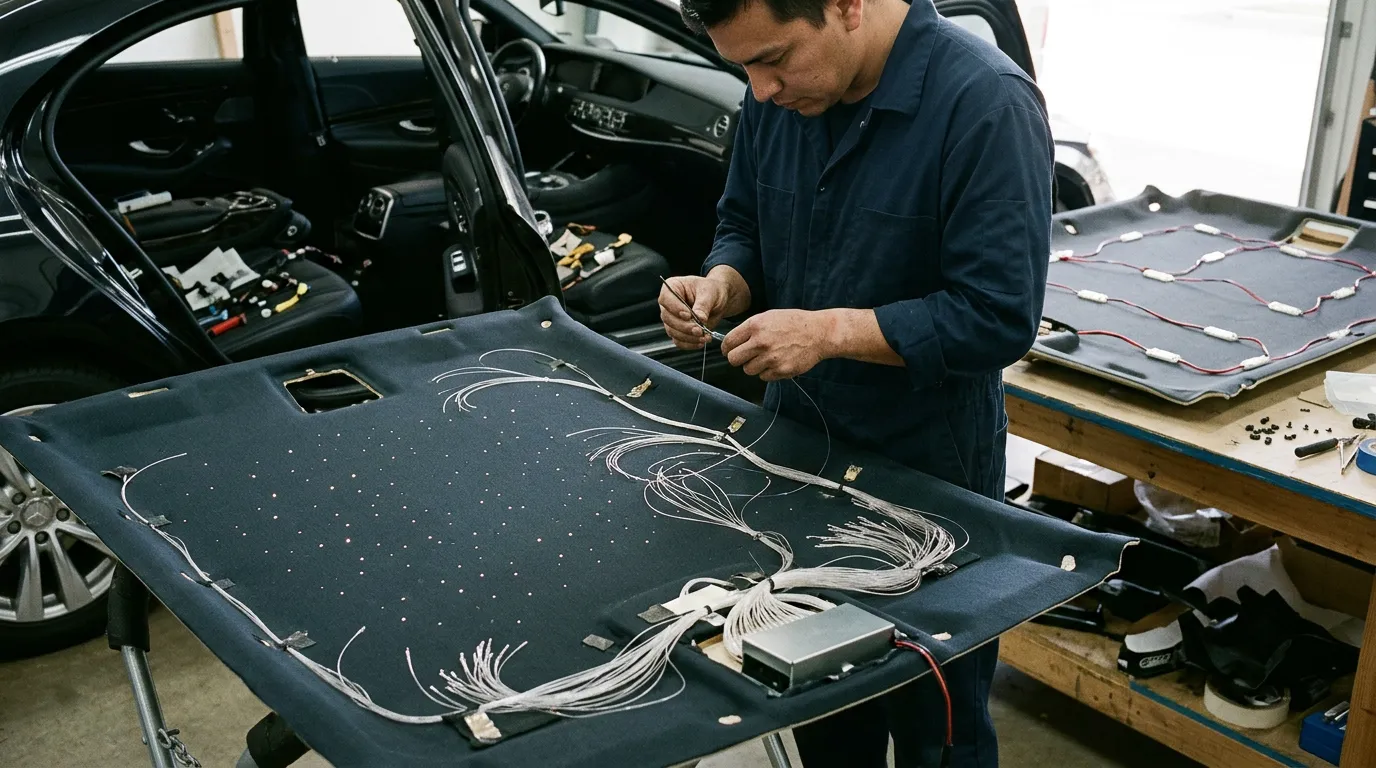
That makes starlight headliner cost much easier to understand when you look at the design rather than only asking for one flat price.
The names can get confusing.
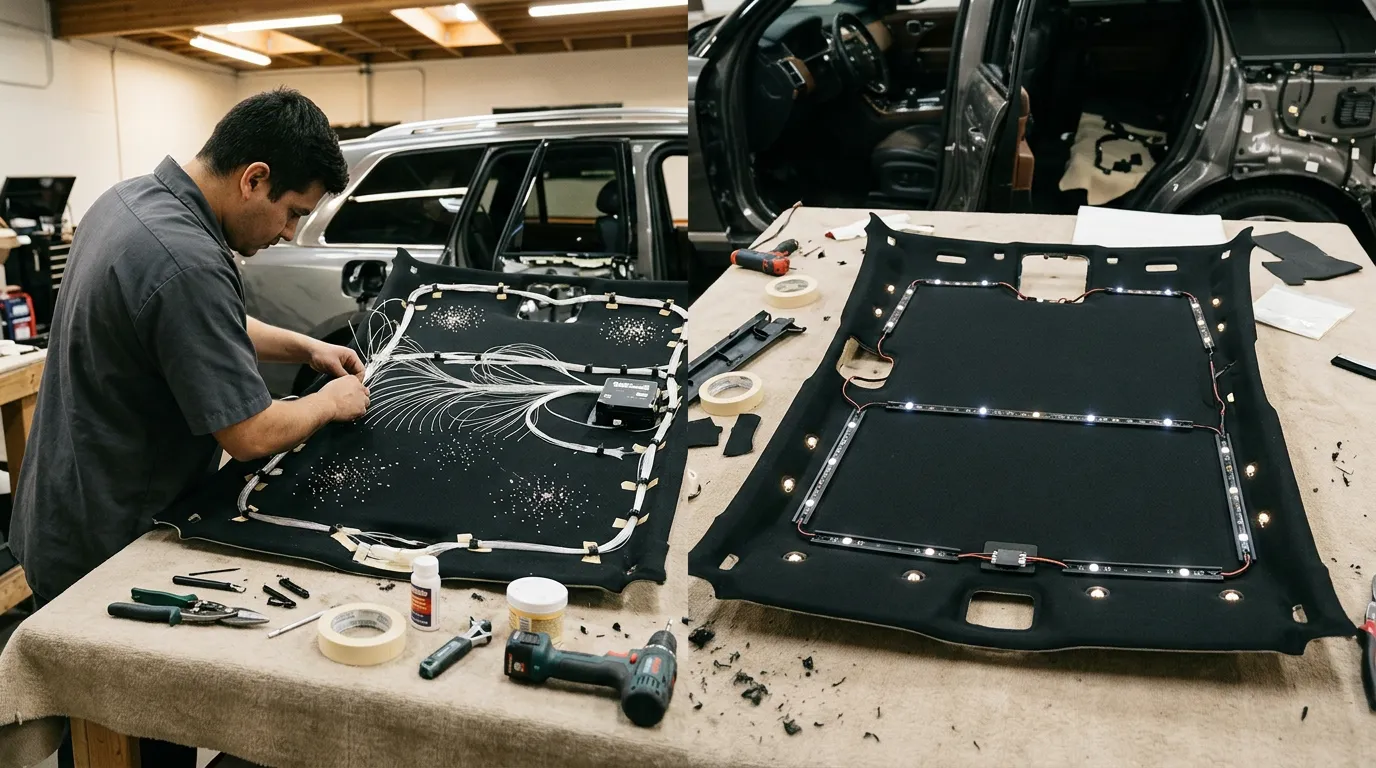
A true starlight headliner usually uses very thin fiber-optic strands routed behind the roof material. Each strand ends at a tiny point in the headliner.
The light itself comes from an LED-powered light engine or illuminator.
That means a fiber-optic starlight headliner still uses an LED light source, but the visible stars are the tips of fiber-optic strands.
A simpler LED setup usually places individual LED modules, strips, pods, or other light sources around the roof or trim.
Here is the practical difference.
A fiber-optic setup usually includes:
A simpler LED setup may use:
The LED route is usually faster and less labor-heavy.
The fiber-optic route is what produces the small, scattered star points associated with luxury starlight roofs.
Professional fiber-optic installations tend to cost more because most of the job is labor.
One 2026 North American pricing guide reports:
Another professional installer lists 400-star and 600-star packages in the roughly $1,450 to $1,600 range and says a standard headliner can require around 15 to 20 hours of work.
Those figures help explain why professional installation costs far more than buying a kit online.
The kit is only one part of the job.
The installer still needs to:
The more stars you add, the more repetitive hand work is required.
LED-based roof lighting can cost less because there may be far fewer individual light points to install.
A 2026 comparison of fiber-optic and LED kits lists typical equipment costs around:
Those are kit prices, not professional installation totals.
A shop installation can cost more depending on:
A basic LED accent setup may stay well below the cost of a custom fiber-optic roof because the installer does not have to place hundreds of individual strands.
What this means is that a lower starlight headliner cost often comes with a different finished appearance.
If what you really want is the Rolls-Royce-style field of tiny stars, fiber optics are usually the closer match.
Labor is the biggest reason.
A fiber-optic starlight headliner may contain several hundred individual fibers.
Each one needs to be placed through the headliner.
A 600-star system can mean hundreds of separate placement steps before the installer even begins trimming the fibers and putting the vehicle back together.
A high-density system with 1,000 or more stars takes even more time.
There is also a design element.
A random-looking night sky is not necessarily random during installation.
The installer needs to avoid obvious rows, clusters, blank sections, dome lights, grab handles, sun visors, microphones, overhead consoles, sunroof openings, wiring, and other roof-mounted components.
That is why labor can quickly become the largest part of the bill.
Star count is one of the easiest ways to understand starlight headliner cost.
This can produce a lighter star pattern.
It may work well on:
This gives the roof a denser appearance.
It can be a good fit for:
This moves toward a much denser custom roof.
It may suit:
Higher counts can raise both parts and labor costs.
A larger fiber bundle may require another light engine or different routing as well.
A larger roof usually means more work.
A compact car may need fewer stars to look full.
A full-size SUV has much more headliner surface area.
That may mean:
The shape of the roof matters too.
A flat roof can be easier to plan than a headliner filled with overhead controls, rear climate vents, entertainment screens, sunroof openings, or multiple roof sections.
This is why an installer usually needs the exact year, make, model, and trim before discussing a firm installation plan.
It can.
A sunroof reduces the amount of normal headliner surface, but it can also make installation more involved.
The installer may need to work around:
A panoramic roof can create an even more unusual layout.
Some customers add LED lighting around the sunroof opening while placing fiber stars in the remaining fabric.
That combination can change the parts and labor needed.
If your vehicle has a sunroof, mention it when requesting a quote.
Usually, yes.
These features require additional hardware or more complicated fiber routing.
An RGB light engine allows the star points to change color.
Depending on the system, you may control it with:
Twinkle-capable systems vary the brightness of star points to create movement.
Shooting-star systems use separate fiber groups or modules to create moving streaks across the headliner.
Each added effect can raise the cost because there are more components to mount, route, wire, and test.
If your priority is keeping the project simpler, a single-color or standard twinkle system may require less hardware.
This depends on the look you want.
For a true star-field appearance, fiber optics usually win.
The visible points can be extremely small because only the tip of the fiber appears through the headliner.
Different fiber thicknesses can also make some stars appear brighter than others.
That creates more depth.
A well-planned fiber installation can look subtle with the lights dimmed and much more dramatic at full brightness.
LED strips or modules usually produce larger visible light sources or washes of color.
They are better suited for ambient interior lighting than for imitating hundreds of tiny stars.
So, if your goal is:
Tiny individual stars: Choose fiber optics.
Color around the roof edges: LED lighting may be enough.
Fast, lower-cost interior lighting: LED can make more sense.
Dense custom night-sky appearance: Fiber optics are usually the better fit.
Either can work in a daily-driven vehicle.
Your priorities determine which one makes sense.
Audio Vision also offers other lighting services for drivers who want to combine interior and exterior lighting changes, including car LED installation.
A starlight headliner is not only an electrical job.
It is also an interior-trim job.
The headliner needs to come down without being bent, cracked, stained, or damaged.
Interior trim may need to be removed.
The installer also has to work around equipment hidden behind the headliner.
Depending on the vehicle, that can include:
This is especially important with side-curtain airbags.
A fiber, light module, wire, or adhesive should never interfere with an airbag deployment path.
Headliner installation guides warn against passing tools or fibers blindly through roof material because important safety equipment and wiring can be hidden behind it.
The finished appearance matters too.
Uneven spacing, obvious patterns, damaged fabric, loose fibers, visible wiring, or poorly reinstalled trim can make an expensive modification look unfinished.
Before scheduling the job, ask the installer exactly what the package includes.
A 300-star roof and a 1,000-star roof are very different jobs.
Ask whether each visible star comes from an individual fiber strand.
This can represent a large amount of labor.
Make sure the quoted work covers getting the vehicle completely reassembled.
Some systems are white only.
Twinkle functions depend on the light engine and controller.
This is often an added feature.
Ask whether it uses a remote, app, Bluetooth, or another controller.
The light engine should be hidden but still placed appropriately for service and ventilation.
A headliner in good condition may be usable.
An older sagging or damaged headliner may require fabric work first.
Audio Vision offers starlight headliner installation for drivers who want custom interior lighting.
The shop serves customers from:
A coupe, sedan, truck, SUV, or custom vehicle can all require different planning.
That is why a vehicle-specific quote makes more sense than relying on a national average.
The final starlight headliner cost depends on your roof size, star count, lighting effects, headliner condition, and the amount of custom work involved.
Audio Vision is located at:
Audio Vision
5521 Holt Blvd
Montclair, CA 91763
Phone: (909) 983-4500
Hours: Monday through Sunday, 9:00 AM to 7:00 PM
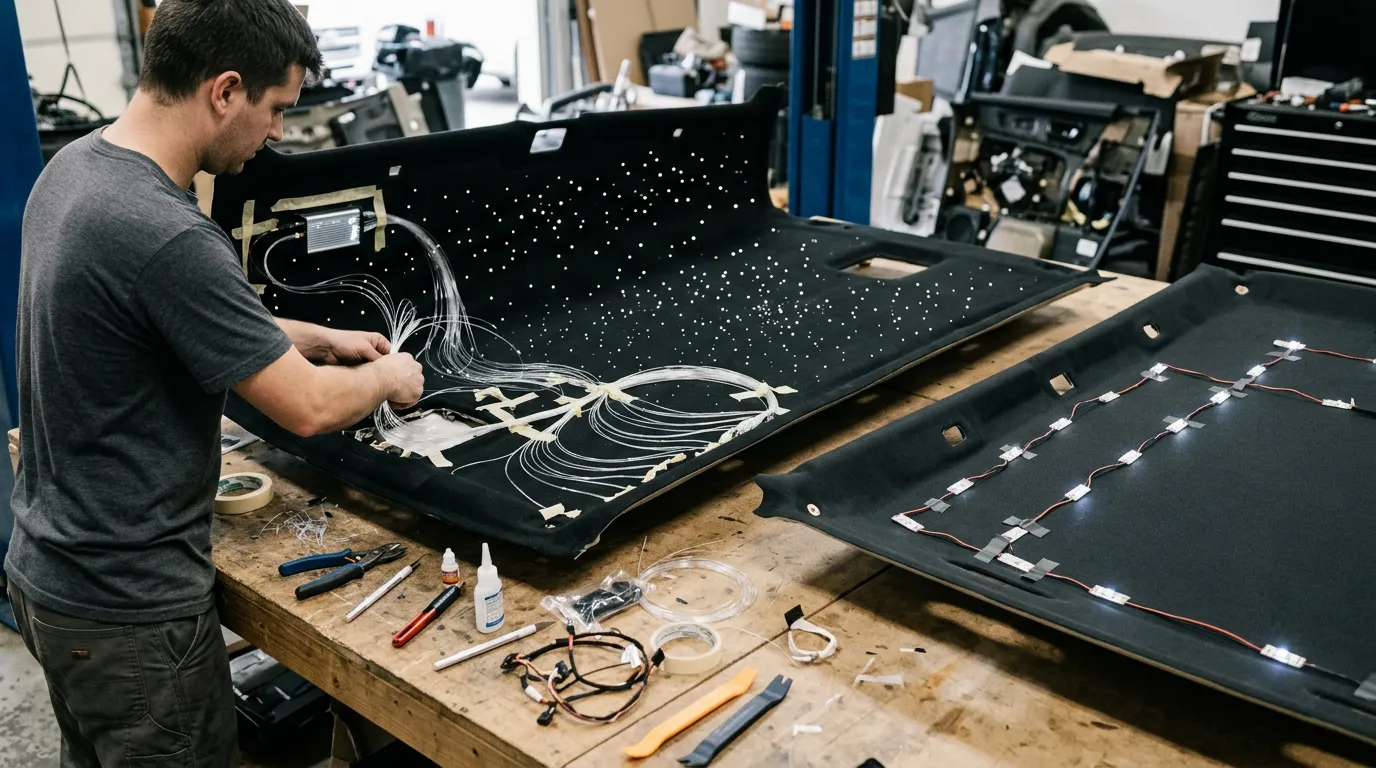
Call (909) 983-4500 or contact Audio Vision online to discuss the look you want and schedule an appointment.
Current professional fiber-optic installations commonly fall around $1,000 to $3,500 or more depending on star count, vehicle size, effects, and labor. A custom shop may charge more for very high star counts, panoramic roofs, replacement headliner material, or advanced effects. These are broad market ranges, not Audio Vision quotes.
Usually. A fiber-optic roof requires hundreds of strands to be individually installed through the headliner, while simpler LED systems can use fewer modules or strips. The added labor is a major reason fiber-optic installations cost more.
Smaller vehicles may look good with 300 to 500 stars, while larger vehicles may use 600 to 1,000 or more. The look you want matters too. A light pattern needs fewer fibers than a dense galaxy-style roof.
Yes. Fiber-optic kits can use RGB light engines that change the color of the light entering the fibers. Many systems also offer remote or app-based control.
Yes. Shooting-star effects are available with certain systems. They usually require extra lighting hardware and fiber routing, so they can raise the installation cost.
It can. The installer has to work around the sunroof opening, tracks, motor, wiring, switches, and headliner layout. Panoramic roofs can require a different star pattern or added accent lighting.
Audio Vision is located at 5521 Holt Blvd, Montclair, CA 91763 and offers starlight headliner installation. Call (909) 983-4500 or use the Audio Vision contact page to discuss star count, colors, effects, and your vehicle.
Looking for the best car audio installation in Montclair, CA? Discover expert tips, top brands, and why Audio Vision is the go-to destination for high-quality car sound systems.
Product Brand: Audio Vision
Product Currency: USD
Product Price: 299
Product In-Stock: InStock

Acima, a flexible lease-to-own option that helps you get the car upgrades you love—without needing perfect credit. Whether you’re looking for car audio, video, security systems, window tint, wheels, auto lighting, or accessories, Acima makes it easy with no credit needed and convenient payment options. Get what you want today and pay over time, hassle-free!

Snap Finance is here to help you get the car audio, video, security, window tint, wheels, lighting, and accessories you need today. With Snap Finance, you can shop now and pay later, thanks to their flexible payment plans that consider more than just your credit score. Applying is fast and easy, and you’ll receive a decision in seconds. Take advantage of stress-free payment options that fit your payday schedule, so you can upgrade your ride without the wait!
Explore the many services we offer by clicking the boxes below


|
|
|
|
|
|
|
|
|
|
|
|
|
|
|
|
Starlight Headliner Cost: Fiber-Optic vs LED Installs Compared
|
Starlight Headliner Cost: Fiber-Optic vs LED Installs Compared
|
Starlight Headliner Cost: Fiber-Optic vs LED Installs Compared
|
Starlight Headliner Cost: Fiber-Optic vs LED Installs Compared
|
|
|
|
|
|
|
|
|
|
|
|
|
|
|
|
|
|
|
|
|
|
|
|
|
|
|