

Looking for the best car audio installation in Montclair, CA? Discover expert tips, top brands, and why Audio Vision is the go-to destination for high-quality car sound systems.
Product Brand: Audio Vision
Product Currency: USD
Product Price: 299
Product In-Stock: InStock
Sagging headliner repair may be enough when a small section of roof fabric has come loose, but widespread separation can point to a bigger problem beneath the visible material. The condition of the foam, backing board, adhesive, edges, and surrounding trim all play a part in deciding whether a repair makes sense or whether replacing the headliner material is the better route.
A sagging headliner often starts quietly. You might notice one corner dropping near the rear window, fabric pulling loose beside a sun visor, or a small bubble forming above the passenger seat. Over time, the loose section may spread farther across the ceiling.
At Audio Vision in Montclair, CA, customers can discuss headliner repair, replacement, and custom starlight headliner work. If you are trying to choose between sagging headliner repair and full replacement, start by looking at how much material has failed and what is happening underneath it.
A car headliner is usually made from more than the cloth you see from the driver’s seat.
Replacement headliner products commonly use foam-backed cloth attached to a formed backing board. Classic Industries, for example, lists replacement automotive headliners made with molded ABS backing covered in foam-backed cloth. See an example in its replacement ABS headliner listing.
As the vehicle ages, the material between the visible fabric and backing can begin breaking down. Once that happens, the cloth may no longer stay firmly against the roof panel.
Heat also matters.
Henkel states that automotive headliner and overhead areas require high-heat-resistant materials because of prolonged exposure to direct sunlight. Its automotive interior information discusses adhesive systems made for headliner bonding and other overhead applications. Read the Henkel automotive interior information.
For drivers in Montclair, CA, Ontario, CA, and Rancho Cucamonga, CA, a vehicle may spend many hours parked outdoors. Over years of ownership, roof material and adhesive can show their age.

Once sagging begins, the next question is whether sagging headliner repair can address the affected section or whether too much of the material has separated.
A limited sagging headliner repair may be worth discussing when the problem is confined to a small section.
That might include fabric beginning to lift around an edge, a small loose area near a trim panel, or limited separation around an opening.
The condition beneath the fabric still matters.
If the underlying material remains stable and the problem is limited to a small area, an installer can inspect whether a repair is practical.
A repair becomes less appealing when the fabric is loose across a wide section of the roof or when the foam underneath has turned brittle and powdery.
Think about the repair area itself.
A two-inch loose edge presents a different situation from half of the roof fabric hanging over the rear seats.
Sagging headliner repair should be based on the condition of the material rather than simply trying to make the loose fabric disappear for a few weeks.
Full replacement becomes worth discussing when the failure has spread beyond one isolated spot.
Signs can include:
If a large amount of foam has deteriorated, there may be little stable material left for a spot sagging headliner repair to bond to.
Full replacement allows the old fabric and deteriorated foam residue to be removed from the board before new material is fitted.
This can also make sense when the rest of the headliner looks close to failing. Repairing one corner today may not help if another section begins separating soon afterward.
The visible fabric does not always tell the whole story.
Many replacement headliner materials use foam backing. Over time, that foam can deteriorate.
If you gently touch a loose area and find dry, crumbly residue behind the fabric, the problem may be within the foam layer rather than just at the adhesive surface.
That matters because adhesive needs something stable to bond.
3M makes a product designed for automotive headliner applications. The company states that its 3M Headliner Adhesive bonds automotive headliners, foam, carpet, and other fabrics to materials such as metal and plastic.
Using the right type of adhesive is only part of the equation.
If old foam is already falling apart, putting adhesive onto deteriorated material may not restore the complete headliner.
When considering sagging headliner repair, ask whether the foam still feels stable or whether the material itself has reached the point where replacement makes more sense.
One of the easiest ways to compare repair with replacement is to look at the size of the damaged area.
A limited loose edge may be a candidate for inspection and repair.
A small section in the middle of the headliner requires a closer look. The installer needs to determine whether the foam underneath that section remains intact.
Multiple sagging spots can suggest that the material is failing across more than one location.
When a large part of the roof fabric has separated, full replacement may be a cleaner approach than trying to reattach each area individually.
This is why photos can help when first contacting a shop about sagging headliner repair, but an in-person look at the material can reveal much more about its condition.
Sagging fabric and water stains can sometimes appear together.
If your headliner has damp spots, rings, or recurring stains, find out where the moisture is coming from before installing fresh material.
Possible areas worth checking can include roof openings, weather seals, glass edges, or nearby roof hardware.
A new headliner should not be used to hide an active water problem.
If moisture continues reaching the roof interior, new material may become stained or damaged.
When requesting sagging headliner repair, tell the shop if you have noticed water marks, damp fabric, or a musty smell around the roof area.
Those details help separate an upholstery problem from a problem that may need another type of vehicle repair first.
The headliner backing board gives the roof material its shape.
Some replacement headliner assemblies use molded ABS plastic, while other vehicle designs may use different formed backing materials.
A board should be inspected for more than fabric separation.
Look for:
A board in good condition may be reusable during full replacement.
A badly damaged backing can change what the job involves.
This is another reason a shop should inspect the vehicle before giving a final answer about sagging headliner repair or replacement.
Headliner adhesive has a real purpose, but a can of adhesive does not automatically make every sagging roof a repair job.
3M states that its headliner adhesive is made for automotive headliners and is designed to bond fabrics to metal and plastic. The company also says the adhesive resists effects from moisture, humidity, heat, and cold.
Henkel likewise identifies heat-resistant bonding as a requirement for automotive headliner and overhead applications.
The condition of the surfaces being bonded still matters.
If the old foam has disintegrated, the adhesive may be applied to loose residue rather than a stable layer.
That is why professional sagging headliner repair starts with inspecting what failed.
If only a suitable bonding point has come loose, repair may be possible.
If the headliner material itself is deteriorating across the roof, new adhesive alone does not replace that worn material.
A common do-it-yourself response to a falling headliner is to push pins, tacks, or staples through the fabric.
This can hold a loose section out of the way, but it does not restore failed foam or create a new bonded surface.
It can also leave visible holes.
As more fabric separates, more fasteners may be needed, and the roof can start looking patched together.
For a vehicle that only needs to keep hanging fabric away from passengers for a short period, a temporary mechanical fix may seem convenient.
For a finished interior, it is worth having the headliner inspected and discussing proper sagging headliner repair or replacement.
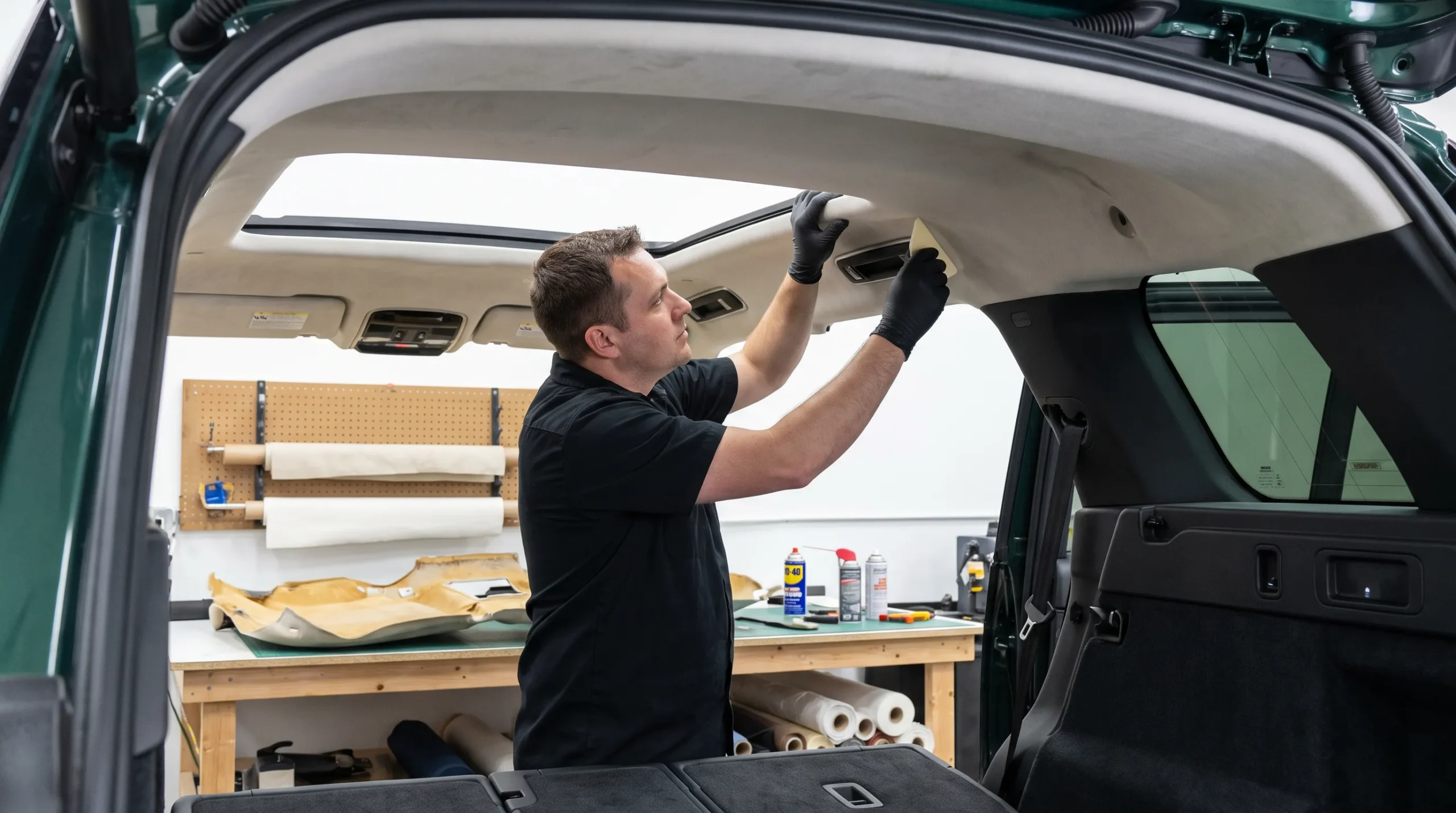
Full replacement usually involves much more than pulling down loose fabric and putting new cloth over it.
The installer first needs access to the backing board.
Depending on the vehicle, this can require removing or loosening items such as:
Audio Vision’s Montclair headliner page describes headliner work that involves accessories and molding around the roof area. You can learn more through its Starlight Headliner Montclair, CA page.
After the board is accessible, old material can be removed.
Deteriorated foam and residue are cleaned away so the replacement material has a suitable surface.
New material is positioned, bonded, wrapped around the needed edges, and trimmed around openings.
Afterward, the board and removed interior pieces are put back into place.
Compared with a small sagging headliner repair, full replacement covers the complete visible material rather than treating one failing section.
The cost depends on what the vehicle needs, so Audio Vision does not need to publish a generic number that may have little connection to your car.
Several factors can change the work involved.
A coupe, sedan, pickup, SUV, and large van can have very different roof dimensions.
A small sagging headliner repair differs from replacing fabric across the complete roof.
Deteriorated foam can require more preparation before new material is installed.
Cracks, warping, or broken mounting areas can change the job.
A sunroof or panoramic roof adds openings, trim, and sometimes a covered sunshade.
Lights, consoles, screens, handles, sensors, and other roof-mounted parts can add removal and reassembly work.
The type, thickness, texture, and color of new material can affect the project.
Old adhesive, staples, pins, or previous upholstery work may need to be removed before the new work begins.
A starlight headliner involves a different scope from a standard fabric replacement.
For information based on your vehicle, call Audio Vision at (909) 983-4500 or use the contact page.
If full replacement already makes sense, you may want to decide whether you want the roof returned to a stock-style appearance or customized.
Audio Vision installs starlight headliners that use points of light across the roof material.
Its Montclair service information describes fiber-optic technology incorporated into the headliner to produce the star effect.
A customer whose existing roof material is already falling may choose to discuss both jobs at the same time.
This does not mean every sagging headliner repair needs custom lighting. Many drivers simply want a clean replacement that matches the rest of the interior.
The decision comes down to what you want from the finished vehicle.
Audio Vision is located at 5521 Holt Blvd, Montclair, CA 91763 and serves vehicle owners throughout the surrounding Inland Empire.
Drivers looking for sagging headliner repair can visit from Montclair, CA, Ontario, CA, Rancho Cucamonga, CA, Claremont, CA, Pomona, CA, Chino, CA, and Chino Hills, CA.
Maybe only the rear edge has started dropping.
Maybe the entire center section is hanging.
Maybe old foam falls away when you touch the fabric.
Maybe you are ready to replace the material and change the appearance at the same time.
The first step is determining what has actually failed.

Audio Vision has served the Inland Empire since 2006 and works with automotive electronics and vehicle customization. Related services include starlight headliners, car audio, car speakers, car LEDs, and window tint.
If you are choosing between sagging headliner repair and full replacement, bring the vehicle to Audio Vision or contact the shop with details about the condition.
Have your vehicle year, make, model, and trim ready.
Also mention:
Photos can also help show the size of the affected area before your appointment.
Audio Vision
5521 Holt Blvd
Montclair, CA 91763
Phone: (909) 983-4500
Hours: Monday through Sunday, 9 a.m. to 7 p.m.
Call (909) 983-4500 or contact Audio Vision online to schedule an appointment and discuss whether repair or replacement fits your vehicle.
Sometimes. A limited sagging headliner repair may be possible when the affected area is small and the material beneath it remains in usable condition. Widespread foam deterioration or large loose sections can make full replacement a better choice.
Loose fabric accompanied by dry, powdery, or crumbly material can point to deterioration behind the visible cloth. An installer can inspect the headliner and determine how much of the material has failed.
Headliner adhesive is designed for automotive fabric bonding, but it still needs suitable surfaces to bond. If the old foam has broken apart, adhesive alone may not address the worn material underneath.
Several loose areas can suggest broader material failure. Full replacement may make more sense when multiple sections have separated, foam is deteriorating, or previous repairs are failing.
Vehicle size, damaged area, material condition, backing board condition, sunroof design, overhead equipment, material selection, previous repairs, and custom work can all affect the job. Call Audio Vision at (909) 983-4500 for information based on your vehicle.
Material choices may allow you to change the color or texture during replacement. The material still needs to work with the vehicle’s headliner board, roof shape, trim, and openings.
Yes. Audio Vision provides starlight headliner installation in Montclair, CA. If your current headliner already needs replacement, call (909) 983-4500 or use the contact page to discuss replacement and custom lighting together.
Looking for the best car audio installation in Montclair, CA? Discover expert tips, top brands, and why Audio Vision is the go-to destination for high-quality car sound systems.
Product Brand: Audio Vision
Product Currency: USD
Product Price: 299
Product In-Stock: InStock

Acima, a flexible lease-to-own option that helps you get the car upgrades you love—without needing perfect credit. Whether you’re looking for car audio, video, security systems, window tint, wheels, auto lighting, or accessories, Acima makes it easy with no credit needed and convenient payment options. Get what you want today and pay over time, hassle-free!

Snap Finance is here to help you get the car audio, video, security, window tint, wheels, lighting, and accessories you need today. With Snap Finance, you can shop now and pay later, thanks to their flexible payment plans that consider more than just your credit score. Applying is fast and easy, and you’ll receive a decision in seconds. Take advantage of stress-free payment options that fit your payday schedule, so you can upgrade your ride without the wait!
Explore the many services we offer by clicking the boxes below


|
|
|
|
|
|
|
|
|
|
|
|
|
|
|
|
Sagging Headliner Repair vs Full Replacement: How to Decide
|
Sagging Headliner Repair vs Full Replacement: How to Decide
|
Sagging Headliner Repair vs Full Replacement: How to Decide
|
Sagging Headliner Repair vs Full Replacement: How to Decide
|
|
|
|
|
|
|
|
|
|
|
|
|
|
|
|
|
|
|
|
|
|
|
|
|
|
|