
Looking for the best car audio installation in Montclair, CA? Discover expert tips, top brands, and why Audio Vision is the go-to destination for high-quality car sound systems.
Product Brand: Audio Vision
Product Currency: USD
Product Price: 299
Product In-Stock: InStock
HELIX DSP tuning for a Ford F-150 can change far more than the bass or treble setting on the factory radio. A properly installed and tuned digital signal processor gives the audio system control over individual speaker channels, crossovers, equalization, time alignment, phase, signal routing, and the factory audio signal before it reaches aftermarket amplifiers and speakers.
That matters in an F-150 because the truck cabin is not an ideal listening room. The left front speaker sits much closer to the person behind the wheel than the right front speaker. Door speakers fire across seats, consoles, glass, carpeting, and hard interior panels. A factory audio system may also apply its own equalization, filtering, delay, or channel-specific processing before an aftermarket system ever receives the signal.
Simply installing expensive speakers and a powerful amplifier does not automatically correct those issues.
Audio Vision in Montclair, CA installs car audio systems, car speakers, car amplifiers, and car subwoofers. For F-150 owners who want more control over the way the finished system sounds, a HELIX processor can become the center of the audio setup.
Here is what HELIX DSP tuning for a Ford F-150 actually does and why the tuning stage can matter as much as the speakers and amplifiers themselves.
A DSP, or digital signal processor, sits between the audio source and the amplification stage in an aftermarket sound system.
Its job is to shape and control audio signals before those signals reach the speakers.
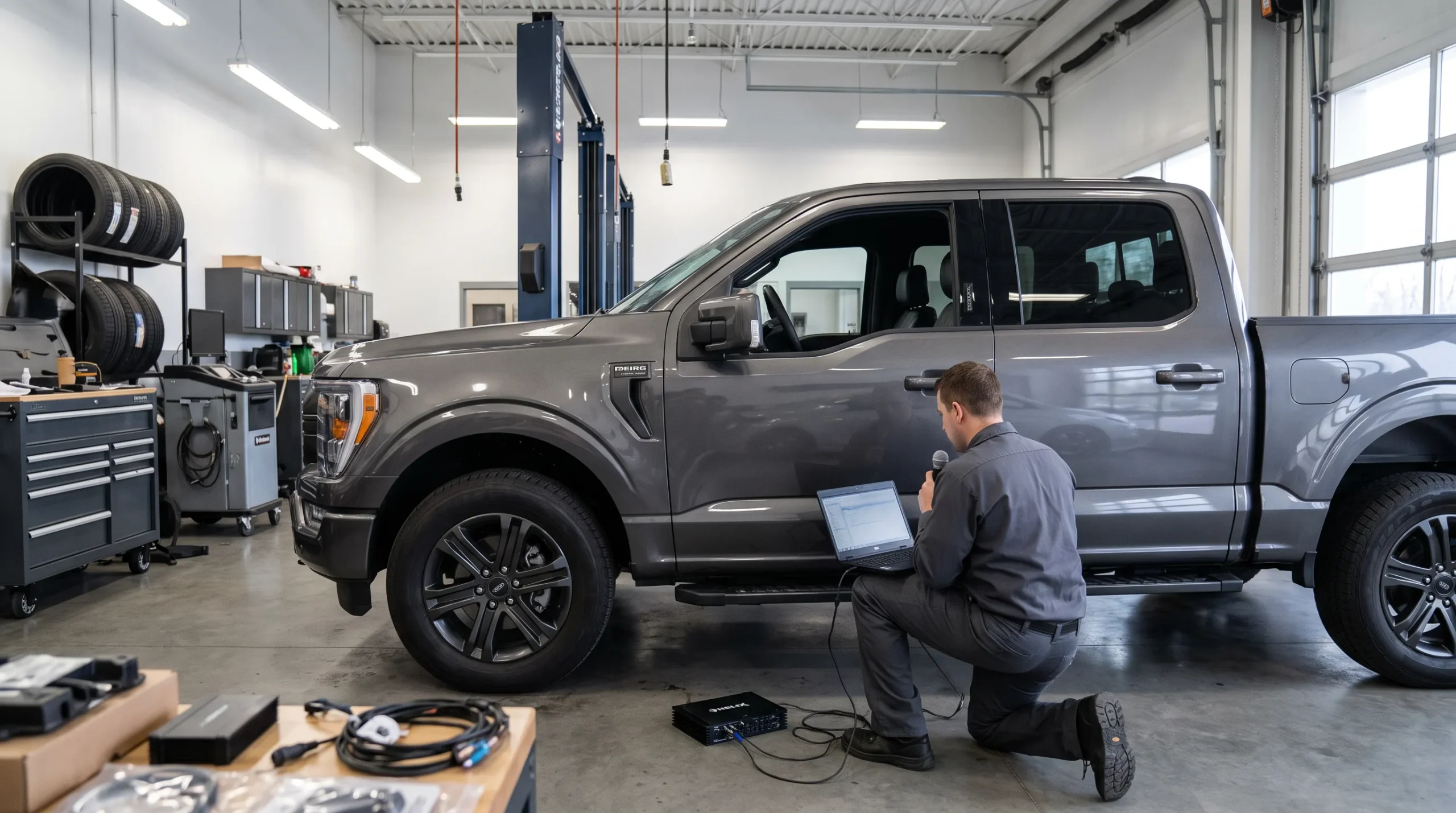
Audiotec Fischer, the company behind HELIX, offers processors such as the HELIX DSP PRO MK3. That model uses a 10-channel output layout and can connect with factory audio systems through high-level inputs.
The processor is configured through Audiotec Fischer’s DSP PC-Tool software.
The software gives the tuner access to functions such as:
This is why HELIX DSP tuning for a Ford F-150 is different from adjusting bass, midrange, and treble on a radio.
The processor can control what happens to individual audio channels instead of making one broad adjustment to the entire system.
Sit behind the wheel of an F-150 and look at where the speakers are located.
The left speaker is close to you.
The right speaker is much farther away.
Rear speakers sit behind your listening position.
A subwoofer may be under or behind a seat.
Those speakers do not reach your ears at the same time or from the same distance.
The truck interior also changes the sound after it leaves each speaker.
Glass reflects sound. Seats absorb some frequencies. Door panels and interior surfaces can create peaks or dips at certain frequencies.
HELIX DSP tuning for a Ford F-150 gives the installer tools to work with those conditions rather than simply installing hardware and accepting whatever happens afterward.
A DSP cannot change the physical shape of the truck.
It can change how each speaker is asked to operate inside that space.
One of the first steps in a factory-radio-based audio system is finding out what signal the truck is already sending.
This point is easy to overlook.
The signal coming from a factory radio or factory amplifier may already have processing applied to it.
Audiotec Fischer explains that original-equipment systems may use equalization, high-pass filters, low-pass filters, delays, phase changes, and other processing.
Its current DSP PC-Tool includes an Input Signal Analyzer that can help identify this behavior.
That means HELIX DSP tuning for a Ford F-150 should not begin by blindly adjusting the aftermarket speakers.
The installer first needs to understand what the factory source is providing.
If the incoming signal already has a strong frequency correction, tuning the speakers without accounting for it can produce a very different result from what was intended.
Audiotec Fischer’s DSP PC-Tool includes an Input Signal Analyzer designed to examine the incoming audio signal.
According to the manufacturer, it can identify filtering and equalization coming from factory systems.
This gives a tuner useful information before the output side of the system is adjusted.
Suppose one factory channel has had low bass removed.
Another channel might carry different frequency content.
A factory tweeter channel may only contain higher frequencies.
If those channels are treated like full-range signals without checking them first, the aftermarket system may be built on an incomplete foundation.
With HELIX DSP tuning for a Ford F-150, input analysis helps answer a simple question:
What signal are we actually starting with?
That answer can guide everything that comes next.
Factory equalization can be designed around factory speakers.
Once those speakers are replaced, the original correction may no longer suit the new equipment.
Audiotec Fischer’s current DSP PC-Tool provides Input EQ so a tuner can compensate for equalization already present in the source signal.
The goal is to create a cleaner starting point before tuning the aftermarket speakers themselves.
This distinction matters.
Input correction deals with what comes from the factory source.
Output EQ deals with how the new speakers behave inside the F-150 cabin.
Those are two different jobs.
A properly planned HELIX DSP tuning for a Ford F-150 session can address both stages rather than trying to fix every problem with one EQ screen.
Some factory systems divide the music across several channels.
One speaker may receive only part of the frequency range while another receives the rest.
Audiotec Fischer’s DSP software supports flexible input and output routing along with combining input signals.
That can be useful when an aftermarket audio system needs a broader signal assembled from multiple factory channels.
The need for this depends on the F-150’s original audio system.
A base factory setup and a premium amplified setup should not automatically be treated the same way.
Signal routing should be checked before amplifiers and speakers are tuned.
This is another reason HELIX DSP tuning for a Ford F-150 should be based on the actual truck rather than a generic preset copied from another installation.
A crossover controls which frequencies a speaker receives.
A tweeter should not be asked to reproduce deep bass.
A subwoofer does not need to reproduce high frequencies.
Door midbass speakers usually operate between those two areas.
Audiotec Fischer’s DSP software provides adjustable high-pass and low-pass filters for individual channels.
That lets the tuner define the frequency range sent to each speaker.
Crossovers can help:
When new car speakers and amplifiers are part of an F-150 build, crossover settings should match the actual equipment.
The setting that works for one speaker model may not suit another.
Time alignment is one of the most noticeable tools available during HELIX DSP tuning for a Ford F-150.
Audiotec Fischer explains that time alignment delays individual speaker channels based on their distance from the listening position.
Why would you intentionally delay a speaker?
Because the driver’s seat is not in the center of the truck.
The left front speaker is much closer to the driver’s ears than the right front speaker. Without correction, sound from the closer speaker arrives earlier.
DSP time alignment can delay the closer channels so sound from several speakers reaches the chosen listening position more closely together.
Audiotec Fischer states that properly set time alignment supports clean spatial reproduction.
In practical terms, vocals can appear more centered across the front rather than sounding like they are coming directly from the nearest door.
That can make a properly tuned system feel very different even when the speakers themselves have not changed.
Once routing, crossovers, time, and phase relationships are addressed, EQ can be used to work on frequency response.
The truck cabin can create peaks and dips that are not present when a speaker is tested outside the vehicle.
Audiotec Fischer’s DSP PC-Tool includes per-channel EQ and real-time measurement tools.
The tuner can measure what is happening from the listening position and adjust selected areas instead of making random bass and treble changes by ear.
This is where HELIX DSP tuning for a Ford F-150 becomes very different from using the factory tone controls.
A DSP can work with individual speaker channels and narrow frequency ranges.
The tuner can hear the result, measure again, and make smaller changes.
Speakers can interfere with one another when their phase relationship is poor around the frequencies where they overlap.
Audiotec Fischer provides phase control within its DSP software and discusses its use when joining a subwoofer with front speakers or joining midrange speakers with tweeters.
This becomes especially useful around crossover points.
If the subwoofer and front speakers do not work together well around their shared frequency range, bass may seem weak in the front seats even when the subwoofer itself is capable of much more output.
The answer is not always turning the subwoofer louder.
Phase and time relationships may need attention first.
A measured HELIX DSP tuning for a Ford F-150 session can address the way these speakers work together instead of treating each component as a separate system.
Channel routing tells the processor where each incoming signal should go.
A multi-channel F-150 build might include:
A processor such as the HELIX DSP PRO MK3 provides ten separately processed line outputs.
Audiotec Fischer also provides configurable routing matrices through its software.
That gives an installer room to build a system where individual speakers can receive their own processed signal and amplifier channel.
This type of fully active arrangement gives far more tuning control than using passive crossovers alone.
Not every F-150 needs ten processed channels.
The processor should match the system being built.
A DSP becomes especially useful when an F-150 receives better speakers.
Audio Vision offers car speaker installation and works with brands such as Focal, JL Audio, JBL, and Rockford Fosgate.
Better speakers give the system different capabilities, but they still need to be set up for the truck.
A DSP can assign:
That lets the installer tune the speakers as part of one system rather than expecting each component to sound right because it came from a respected brand.
Adding a car subwoofer to an F-150 can provide the low-frequency output that door speakers cannot deliver in the same way.
DSP control can help connect that bass to the front speakers.
The tuner can adjust:
The goal is not merely to hear bass from behind or beneath the seat.
A well-blended subwoofer should sound like part of the complete system.
That is another place where HELIX DSP tuning for a Ford F-150 can make a clear difference.
No.
Two F-150s can need different settings even when they share the same model year.
Differences can include:
The factory system can vary too.
Ford currently lists different audio equipment across the F-150 range. On the 2025 F-150 page, the Lariat is shown with a B&O Unleashed system using eight speakers including a subwoofer.
Other F-150 configurations can use different factory audio equipment.
This is why downloading somebody else’s tune and assuming it will fit your truck can miss the point of a DSP.
The tune should belong to the system in front of the tuner.
An F-150 with a factory premium B&O system may present a different input signal from a truck with base audio.
The premium system can have more speaker channels and factory processing.
A base system may use another signal path.
Before HELIX DSP tuning for a Ford F-150 begins, Audio Vision can inspect which factory system is present.
That can determine:
If the system already has an audio problem, car audio troubleshooting may come before tuning.
A DSP should not be used to hide a damaged speaker, loose connection, or failing amplifier.
A tuning microphone can show what the listener is actually hearing at the seat.
Audiotec Fischer’s DSP software includes real-time analysis tools designed for use with measurement equipment.
This gives the tuner a visual view of the frequency response in the truck.
Measurements can help identify:
Listening still matters.
The microphone does not decide what music should sound like for the owner.
It gives the tuner another tool for identifying what the cabin and speakers are doing.
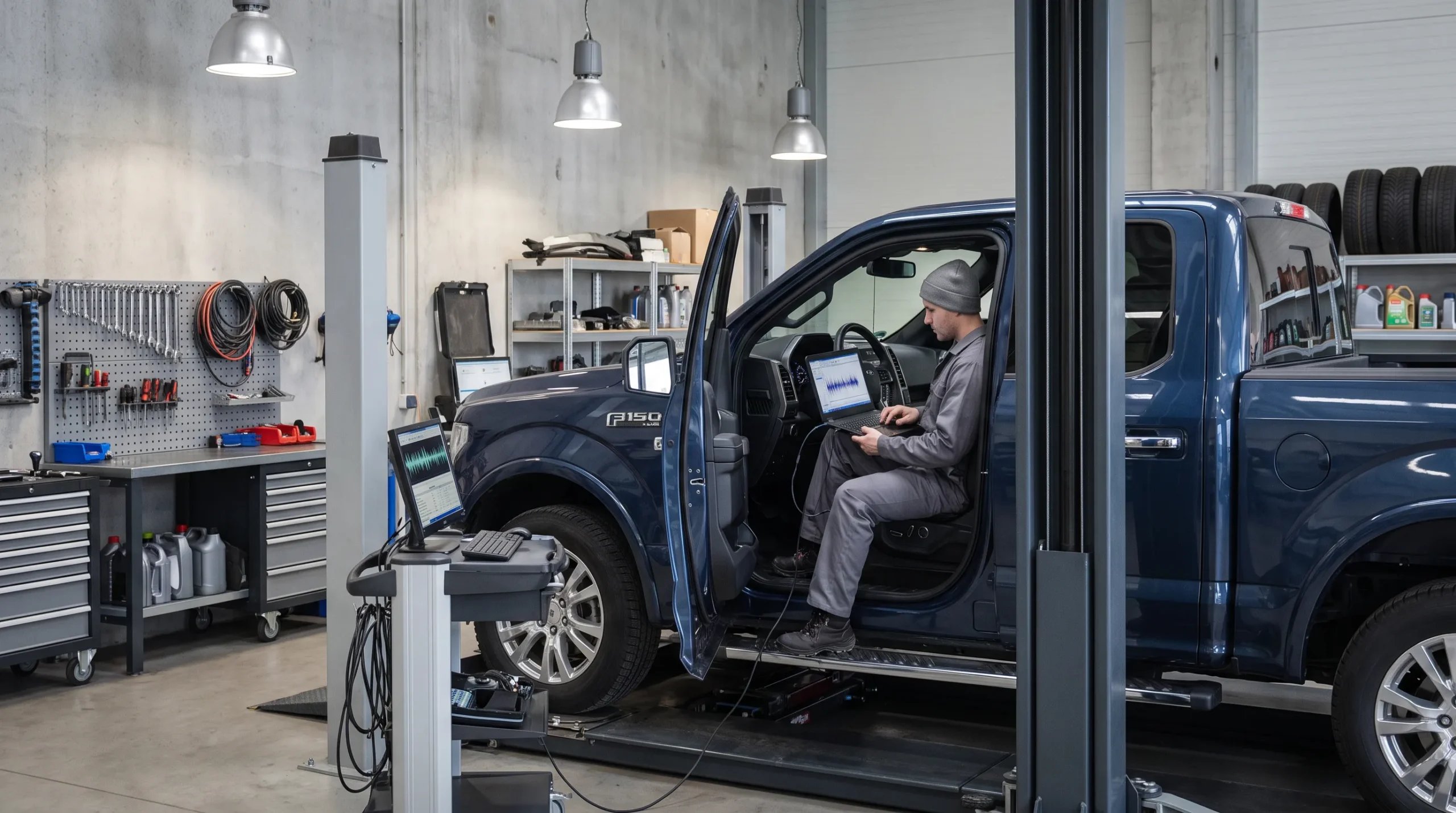
The strongest HELIX DSP tuning for a Ford F-150 combines careful setup, measurements, and listening rather than relying on one method alone.
The exact process depends on the installed system, but a HELIX DSP project can involve several stages.
The tuner checks the F-150 model year, cab, factory stereo, factory amplifier, and speaker configuration.
Speaker models, amplifier channels, subwoofer configuration, wiring, and processor connections are confirmed.
Factory EQ, filtering, delay, and available frequency content can be checked.
The incoming channels are assigned or combined as needed.
Each DSP output is assigned to the correct amplifier and speaker channel.
High-pass and low-pass filters are set around the capabilities of the installed speakers.
Channel levels are adjusted so one speaker does not dominate simply because of its location or sensitivity.
Individual channels are delayed to account for speaker distance from the chosen listening position.
Speakers are checked around their crossover regions so adjacent drivers work together.
A measurement microphone can show how the system behaves in the truck.
Selected frequency areas are adjusted based on measurements and listening.
The subwoofer and front speakers are adjusted so bass connects with the rest of the system.
Measurements are followed by real listening from the seat.
That complete process explains why HELIX DSP tuning for a Ford F-150 is not just plugging a laptop into a processor and selecting a preset.
Audio Vision provides car audio installation and tuning at 5521 Holt Blvd, Montclair, CA 91763.
F-150 owners visit from Montclair, CA and nearby Ontario, CA and Rancho Cucamonga, CA for speaker, amplifier, subwoofer, and processor-based audio systems.
One F-150 owner may want to keep the factory radio while changing the rest of the system.
Another may already have aftermarket speakers and amplifiers but feel that the system never sounds centered.
Someone else may have plenty of bass but poor blending between the subwoofer and front doors.
Those are all situations where HELIX DSP tuning for a Ford F-150 may be worth discussing.
Audio Vision has served the Inland Empire since 2006 and can work on the complete audio chain rather than treating the processor as an isolated piece of equipment.
Before scheduling HELIX DSP tuning for a Ford F-150, gather information about the truck and current audio system.
Have these details ready:
Tell Audio Vision what you hear from the system now.
Does the vocal image pull toward the driver’s door?
Is the bass strong but disconnected from the front speakers?
Does the system become harsh when turned up?
Are the new speakers better than stock but still not producing the sound you expected?
Those details help define the tuning goals.
Audio Vision
5521 Holt Blvd
Montclair, CA 91763
Phone: (909) 983-4500
Hours: Monday through Sunday, 9 a.m. to 7 p.m.
Call (909) 983-4500 or contact Audio Vision online to discuss your Ford F-150 audio system and schedule an appointment.
HELIX DSP tuning for a Ford F-150 can control input correction, channel routing, speaker crossovers, time alignment, phase, individual speaker levels, equalization, and subwoofer blending. The settings depend on the factory signal and aftermarket equipment installed in the truck.
A DSP can change the signals sent to compatible speakers, but it cannot repair a damaged speaker or give a speaker physical capabilities it does not have. Some systems benefit from DSP work with factory speakers, while larger changes may call for new speakers and amplifier power.
An amplifier and DSP perform different jobs. The amplifier supplies power, while the DSP controls and shapes the audio signal. An amplified system can still benefit from crossover, time, EQ, phase, and routing adjustments.
HELIX processors are designed with high-level inputs and signal-processing tools that can connect with many original-equipment audio sources. The exact F-150 factory system should be inspected before selecting the processor and connection method.
The driver’s seat is much closer to some speakers than others. Time alignment delays selected speaker channels so their sound can arrive at the listening position more closely together. This can move vocals and instruments away from the nearest door and toward a more centered front presentation.
Yes. A DSP can control subwoofer level, crossover, time delay, phase, and EQ. Those settings can help the subwoofer work more naturally with the front speakers instead of sounding like a separate source of bass.
Audio Vision provides car audio, speaker, amplifier, subwoofer, and audio troubleshooting services at 5521 Holt Blvd, Montclair, CA 91763. Call (909) 983-4500 or use the Audio Vision contact page to schedule an appointment.
Looking for the best car audio installation in Montclair, CA? Discover expert tips, top brands, and why Audio Vision is the go-to destination for high-quality car sound systems.
Product Brand: Audio Vision
Product Currency: USD
Product Price: 299
Product In-Stock: InStock

Acima, a flexible lease-to-own option that helps you get the car upgrades you love—without needing perfect credit. Whether you’re looking for car audio, video, security systems, window tint, wheels, auto lighting, or accessories, Acima makes it easy with no credit needed and convenient payment options. Get what you want today and pay over time, hassle-free!

Snap Finance is here to help you get the car audio, video, security, window tint, wheels, lighting, and accessories you need today. With Snap Finance, you can shop now and pay later, thanks to their flexible payment plans that consider more than just your credit score. Applying is fast and easy, and you’ll receive a decision in seconds. Take advantage of stress-free payment options that fit your payday schedule, so you can upgrade your ride without the wait!
Explore the many services we offer by clicking the boxes below


|
|
|
|
|
|
|
|
|
|
|
|
|
|
|
|
HELIX DSP Tuning for a Ford F-150: Why a Processor Changes Everything
|
HELIX DSP Tuning for a Ford F-150: Why a Processor Changes Everything
|
HELIX DSP Tuning for a Ford F-150: Why a Processor Changes Everything
|
HELIX DSP Tuning for a Ford F-150: Why a Processor Changes Everything
|
|
|
|
|
|
|
|
|
|
|
|
|
|
|
|
|
|
|
|
|
|
|
|
|
|
|