
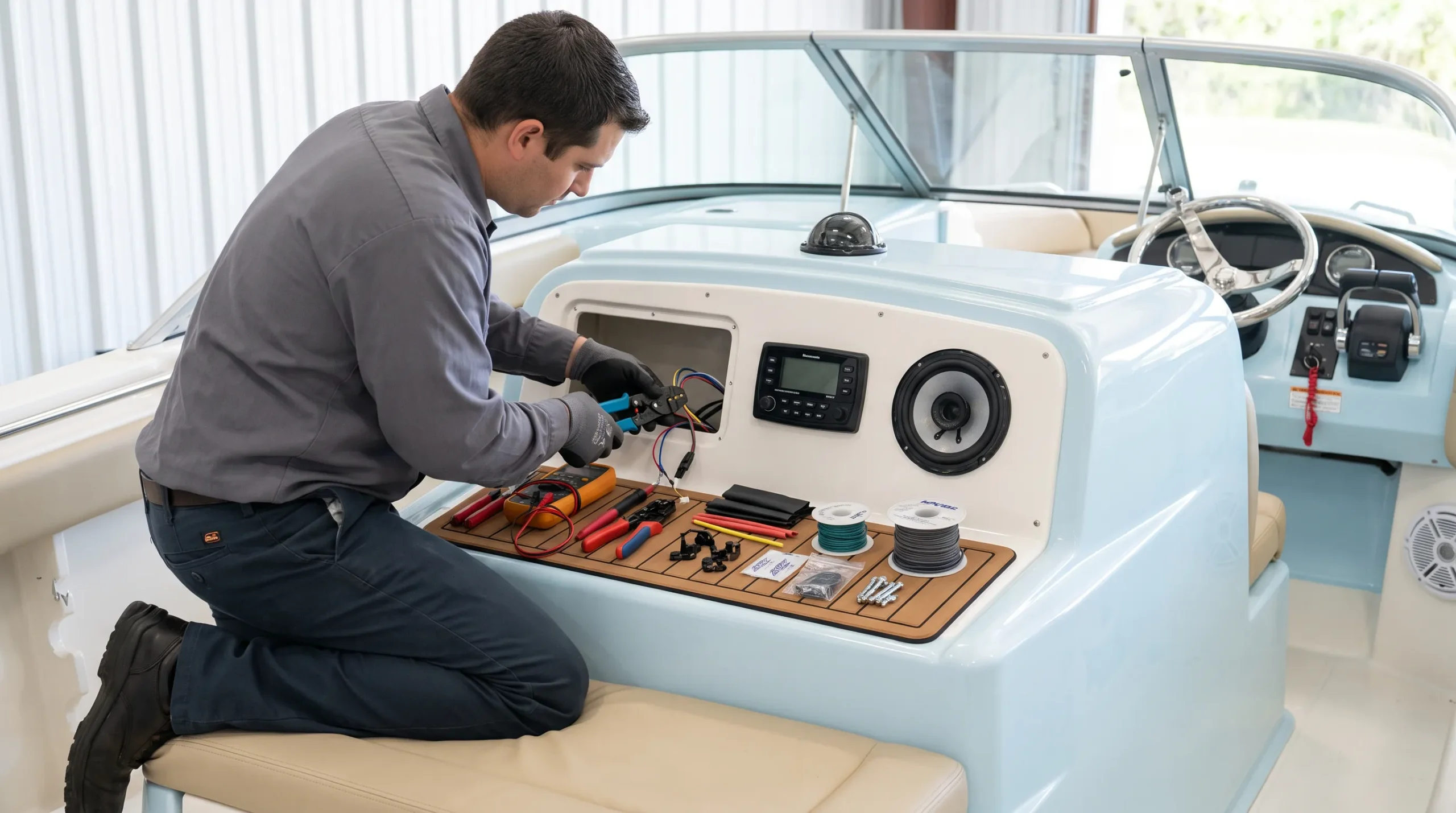
Looking for the best car audio installation in Montclair, CA? Discover expert tips, top brands, and why Audio Vision is the go-to destination for high-quality car sound systems.
Product Brand: Audio Vision
Product Currency: USD
Product Price: 299
Product In-Stock: InStock
Boat stereo installation requires equipment and installation methods made for conditions that would be unusually harsh for most car audio systems. Water spray, salt, humidity, direct sunlight, heat, vibration, and long periods outdoors can all affect speakers, amplifiers, wiring, terminals, and stereo controls.
That is why putting car audio equipment into a boat is not always a good substitute for true marine gear.
Marine speakers can use UV-resistant materials, sealed motor structures, corrosion-resistant parts, and designs tested against salt fog and moisture. Marine amplifiers can be made with coatings and connections intended for use around water. Wiring and circuit protection also deserve careful planning because a boat’s electrical layout is different from a car’s.
Audio Vision in Montclair, CA provides boat audio installation for boat owners who want music at the dock, on the lake, or while cruising.
If you are researching boat stereo installation, here is what to know about marine speakers, amplifiers, subwoofers, source units, wiring, weather protection, and system layout.
A car stereo usually spends its life inside a roofed passenger cabin.
A boat audio system lives in a much harsher setting.
Even equipment mounted under a console may encounter humidity, condensation, water spray, and changing temperatures. Speakers mounted in open seating areas may sit in direct sunlight for hours.
Saltwater adds another concern because salt can attack exposed metal and electrical connections.
True marine audio products are built with these conditions in mind.
KICKER states that its marine speakers and subwoofers are made for boat use and tested for salt fog and UV exposure. Its Premium Marine line meets or exceeds ASTM testing for salt-fog and accelerated UV exposure.
Rockford Fosgate also makes marine speakers with water-intrusion ratings and materials intended to resist salt and UV exposure.
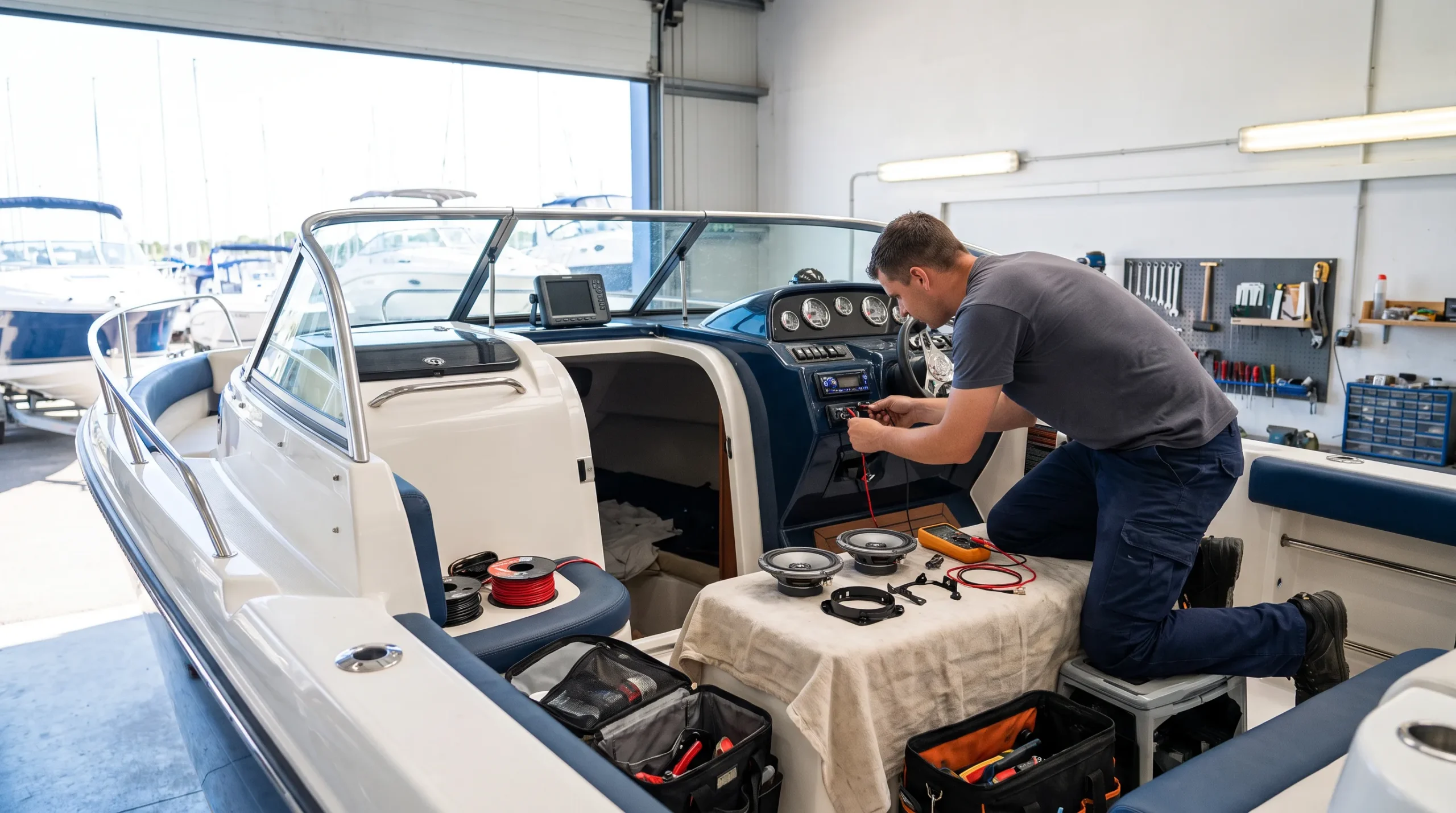
That is why boat stereo installation should start by asking whether the equipment is actually designed for marine use.
There is no single feature that turns an ordinary speaker into marine equipment.
A marine speaker may use several construction choices intended to cope with the environment.
These can include:
KICKER’s marine coaxial speakers are tested against ASTM standards for UV and salt-fog exposure.
Rockford Fosgate’s M2 marine speakers use UV and salt-fog-resistant surrounds and carry an IPX6 water-intrusion rating.
These details matter during boat stereo installation because the speaker face may be exposed directly to spray and sun.
A regular car speaker may sound good when new but may not be made for years of outdoor exposure.
Sunlight can be hard on plastics, rubber, speaker surrounds, grilles, and cones.
A boat may sit uncovered at a dock or spend hours under direct sun while you are on the water.
UV-resistant materials are designed to withstand that exposure better than materials that were intended to remain inside a vehicle.
KICKER says its Premium Marine products meet or exceed ASTM G154 accelerated UV testing.
Rockford Fosgate uses UV-stable materials in several marine speaker lines.
This does not mean marine equipment will remain visually unchanged forever.
It means the manufacturer has built and tested the product for an outdoor environment.
When comparing speakers for boat stereo installation, look at the manufacturer’s UV claims instead of relying only on speaker size and wattage.
Freshwater and saltwater boats both need equipment that can cope with moisture.
Saltwater raises the corrosion concern.
Salt can remain on surfaces after water dries, which means speaker hardware, wire terminals, amplifier connections, and other metal pieces need attention.
Marine manufacturers commonly use salt-fog testing to evaluate their equipment.
KICKER’s Premium Marine line is tested to ASTM B117 salt-fog standards.
Rockford Fosgate also lists ASTM B117 salt-fog testing on selected marine speakers and subwoofers.
If your boat regularly sees ocean or coastal use, mention that when planning boat stereo installation.
Equipment, connectors, mounting hardware, and maintenance habits can all be chosen with salt exposure in mind.
You may see an IP rating on marine speakers, amplifiers, and other electronics.
An IP rating refers to tested protection against intrusion under defined conditions.
Rockford Fosgate’s M2 8-inch marine speakers, for example, carry an IPX6 water-intrusion rating.
An IPX6 rating does not mean every part can be mounted underwater.
It refers to the tested level of protection described by the manufacturer’s rating.
Do not assume every piece of marine equipment has the same rating.
One speaker may carry IPX6 while another amplifier or stereo may have a different rating or use another form of weather protection.
For boat stereo installation, check the rating of each product and plan its mounting location around what that product is made to handle.
Boat speaker choice begins with where you want to hear the music.
A small runabout may only need a few coaxial speakers.
A larger boat may use speakers across several seating areas.
A wake boat may combine cockpit speakers with tower speakers aimed toward riders behind the boat.
Speaker size can affect output and available low-frequency response, but physical fit is just as relevant.
Check:
Audio Vision works with marine-capable audio brands that include KICKER, Rockford Fosgate, and JL Audio.
The right speaker depends on the boat and how the audio system will be used.
Speaker placement can affect the finished system as much as the speaker model.
A speaker needs a solid mounting surface with enough space behind it.
It should also aim toward the area where people will listen whenever the boat layout allows it.
Common locations can include:
Before cutting a speaker opening, the installer needs to know what is behind the panel.
Boat panels can hide:
Cutting first and checking later can create a much larger problem than poor speaker fit.
Careful planning matters during boat stereo installation, particularly when adding speakers where the boat did not originally have them.
Tower speakers serve a different purpose from normal cockpit speakers.
They are often mounted high on a wake tower and aimed outward.
This can help project music farther from the boat.
Rockford Fosgate and KICKER both make marine tower speaker systems designed for outdoor use.
KICKER’s KMTC tower systems use UV-treated enclosures and marine speaker materials. The company also tests its marine gear for salt-fog exposure.
Tower speakers need strong mounting hardware because they experience movement, vibration, and wind while the boat is underway.
Cable routing through or around the tower also needs to avoid sharp edges and loose wire runs.
If tower audio is part of your boat stereo installation, plan the speaker, amplifier, mounting clamps, and wiring together.
Speakers often need more power when they are playing in open air.
There is no enclosed cabin to hold sound around the listener.
A marine amplifier can supply more power to the cockpit speakers, tower speakers, or subwoofer.
The amplifier should be selected around:
A four-channel amplifier may power two pairs of speakers.
A mono amplifier can power a subwoofer.
A larger multi-channel system may use more than one amplifier.
When planning boat stereo installation, choose the amplifier after you know how many speakers and subwoofers it needs to run.
Marine does not mean that an amplifier should be placed directly in the wettest part of the boat.
A protected mounting location is still preferable.
Possible locations may include:
The amplifier needs suitable space for wiring and heat management.
The installer also needs access for servicing and adjustments.
Avoid areas where:
KICKER warns that amplifiers installed in areas where flammable fuel vapors can accumulate call for suitable marine fuses, fuse holders, and wiring.
Boat electrical work needs to account for the boat’s fuel and electrical layout, not just find an empty place to mount the amplifier.
A subwoofer can add the low frequencies that smaller cockpit speakers cannot reproduce with the same output.
Marine subwoofers can be installed in several ways depending on the product and boat.
Options may include:
Some marine subwoofers are designed to operate without a conventional sealed enclosure when mounted into a suitable panel.
A sealed marine enclosure can give the subwoofer its own air space.
Rockford Fosgate currently sells marine subwoofers in sealed enclosures with IPX6 water-intrusion ratings on selected models.
A custom enclosure can be built around available boat space when the subwoofer specifications support that design.
The right approach depends on how much bass you want, available room, and how much storage space you want to keep.
Audio Vision also installs car subwoofers and can discuss how a marine bass system differs from a typical vehicle installation.
The source unit is the part of the system you use to select music and control volume.
Marine media centers may support:
A boat stereo should be selected for its mounting environment.
If the unit sits in an exposed dashboard, water and UV resistance become more relevant.
If it is mounted inside a protected cabin, exposure may be lower.
Some boat owners also prefer a small digital media receiver instead of a traditional large radio because dashboard space is limited.
During boat stereo installation, decide how you want to control the system before choosing the source unit.
Think about where you will stand or sit most often while changing tracks or volume.
Wiring is one area where boat audio and car audio can differ greatly.
Water and corrosion need to be taken seriously.
Marine wiring and connections should suit the boat environment.
ABYC maintains standards covering AC and DC electrical systems on boats, including its E-11 standard.
ABYC’s current training also covers marine-grade wiring, grounding, batteries, circuit protection, and electrical connections.
For an audio installation, the wiring plan can include:
Connections should be secured so vibration does not leave wires loose.
Saltwater boats deserve close attention around exposed terminals because corrosion can increase resistance and create unreliable connections.
Amplifier power circuits need proper circuit protection.
KICKER specifically warns boat installers to use appropriate marine fuses, marine fuse holders, and marine wiring where flammable fuel vapors can accumulate.
Blue Sea Systems also makes marine fuse blocks designed for boat electrical systems, including ignition-protected products for gasoline-powered boat applications.
A fuse is not there to make the stereo sound better.
It protects the electrical circuit when current exceeds the intended level.
Fuse type, rating, cable size, and location should be selected around the installed equipment and boat electrical design.
This is a part of boat stereo installation that should not be treated like a cosmetic detail.
Gasoline-powered boats require extra care around areas where fuel vapors may collect.
Federal recreational-boat electrical rules address ignition protection for covered electrical components in boats with gasoline engines, subject to the scope and exceptions in the regulations.
This matters because an electrical device or connection that can create a spark should not be placed casually in a gasoline-vapor area.
Amplifier location, fuse location, and other electrical equipment should be planned with the boat’s fuel system in mind.
If you have an inboard or sterndrive gasoline boat, tell the installer where the fuel tank, engine compartment, batteries, and existing electrical equipment are located.
A boat stereo installation should work with the boat’s electrical and fuel design rather than treating it like an oversized car.
A large stereo can draw a meaningful amount of electrical power.
That becomes more noticeable when music is playing for a long time with the engine off.
The system size should be considered alongside:
Some boats use separate starting and house battery arrangements.
The actual electrical setup needs to be checked before deciding where the stereo and amplifiers should draw power.
Blue Sea Systems publishes marine battery and circuit diagrams for several battery-switch arrangements.
If you want to run a high-output system for long periods while anchored, mention that during the planning stage.
It may affect how the boat stereo installation is designed.
There is no universal speaker count.
Start with the boat layout.
A smaller boat might sound good with four well-placed speakers.
A larger boat may need separate coverage for the bow, cockpit, cabin, and rear seating areas.
Tower speakers add another listening zone.
A good way to think about speaker count is to ask where people will be sitting.
If people in the bow can barely hear the rear speakers, adding volume to the rear may only make that seating area too loud.
Placing speakers closer to each listening area can create more even sound.
Some marine stereo systems also support separate zones so different parts of the boat can have independent level control.
This can be useful when one group is sitting in the cockpit while another is in the bow.
The cost of boat stereo installation depends on the boat and the audio system.
Audio Vision does not need to publish a generic figure that may not match your project.
Factors can include:
A straightforward speaker replacement is a different job from a complete system with tower speakers, several amplifiers, a subwoofer, and new wiring.
Call Audio Vision at (909) 983-4500 or use the Audio Vision contact page to discuss the boat and the type of audio system you want.
Audio Vision provides boat audio installation from its shop at 5521 Holt Blvd, Montclair, CA 91763.
Boat owners from Montclair, CA and nearby Ontario, CA and Rancho Cucamonga, CA can contact the shop about marine speakers, amplifiers, subwoofers, source units, and system wiring.
One owner may want to replace speakers that have been damaged by years of sun exposure.
Another may want a marine amplifier so the system remains clear while cruising.
A wake-boat owner may want tower speakers aimed behind the boat.
Someone else may want deeper bass while keeping as much storage space as possible.
Each boat stereo installation should be based on the boat, water exposure, electrical system, and listening goals.
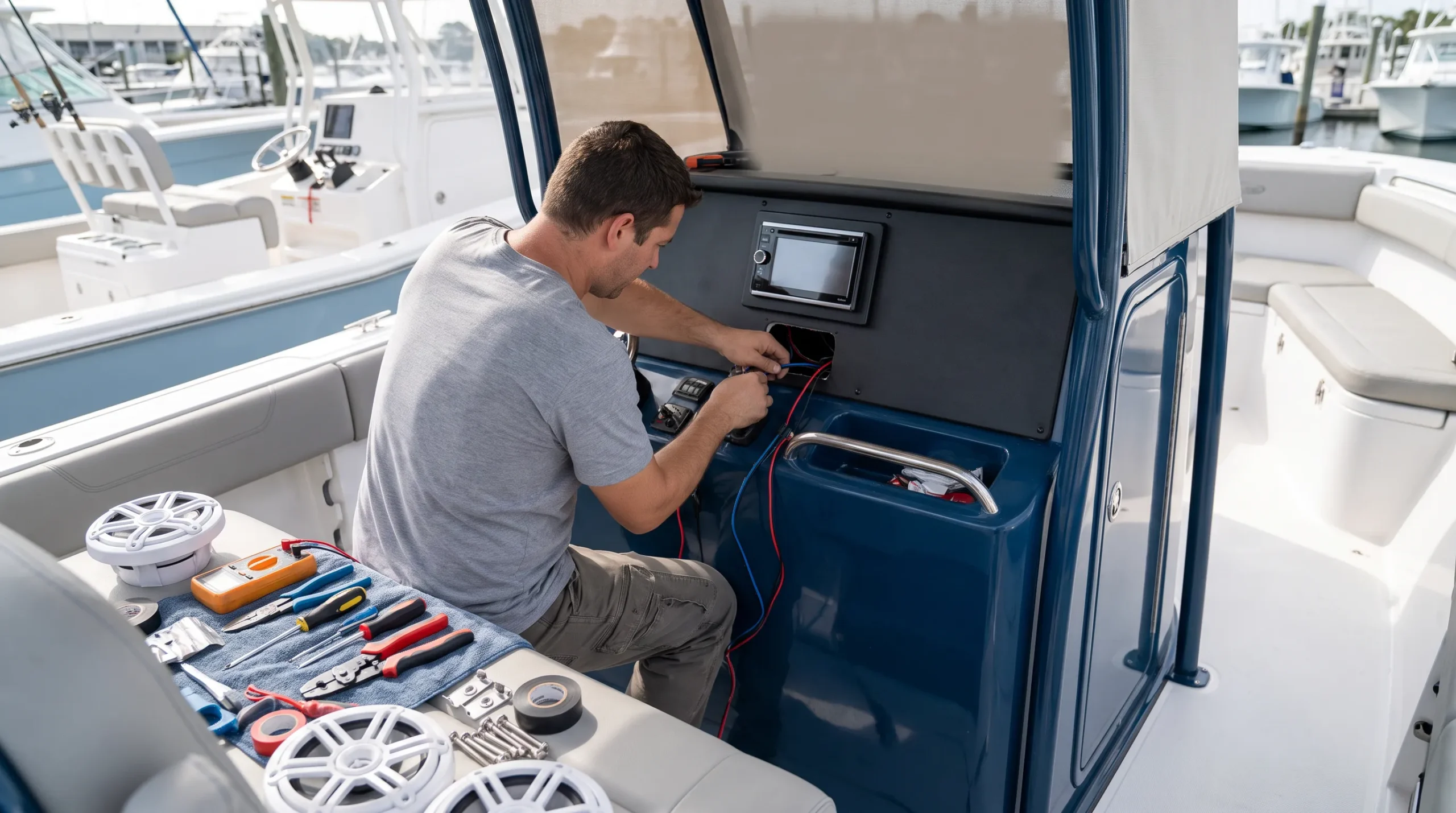
Audio Vision has served the Inland Empire since 2006 and works with audio brands that include KICKER, Rockford Fosgate, JL Audio, and JBL.
Before scheduling boat stereo installation, gather some information about your boat and existing audio system.
Have these details ready:
Then think about what you want to change.
Do you need louder cockpit sound?
Are the current speakers damaged from sunlight or water?
Do you want music projected from the tower?
Do you want stronger bass?
Do you listen for long periods while anchored?
Do you want different volume levels in different parts of the boat?
These answers help determine the speaker locations, amplifier channels, electrical needs, and weather protection the system calls for.
Audio Vision
5521 Holt Blvd
Montclair, CA 91763
Phone: (909) 983-4500
Hours: Monday through Sunday, 9 a.m. to 7 p.m.
Call (909) 983-4500 or contact Audio Vision online to discuss your boat and schedule an audio installation appointment.
Marine speakers can use materials and construction intended for water, humidity, salt, sunlight, and outdoor use. KICKER tests its marine speakers for UV and salt-fog exposure, while selected Rockford Fosgate marine speakers carry water-intrusion ratings such as IPX6.
Equipment mounted on a boat can experience far more water, UV exposure, salt, and humidity than typical car audio equipment. Marine gear is made and tested with those conditions in mind. The level of protection still differs by product, so check the specifications of every speaker, amplifier, and source unit.
Some marine amplifiers are built to withstand more moisture than typical car amplifiers, but the level of protection depends on the model. A protected mounting location is still a smart choice. Check the manufacturer’s rating before deciding where an amplifier should go.
Many marine speakers are tested for salt-fog exposure. KICKER and Rockford Fosgate both publish salt-fog testing information for selected marine products. Saltwater still calls for sensible cleaning and maintenance of the boat and exposed audio components.
Yes. Marine subwoofers are available in free-air, enclosed, and other configurations. The right choice depends on mounting space, amplifier power, desired bass output, and whether the subwoofer location will see water or direct sunlight.
It depends on the boat’s existing batteries, charging system, amplifier power, and how long you play the stereo with the engine off. Have the electrical system checked before deciding whether battery changes belong in the project.
Audio Vision provides boat audio installation at 5521 Holt Blvd, Montclair, CA 91763. Call (909) 983-4500 or use the Audio Vision contact page to discuss marine speakers, amplifiers, subwoofers, wiring, and stereo installation.
Looking for the best car audio installation in Montclair, CA? Discover expert tips, top brands, and why Audio Vision is the go-to destination for high-quality car sound systems.
Product Brand: Audio Vision
Product Currency: USD
Product Price: 299
Product In-Stock: InStock

Acima, a flexible lease-to-own option that helps you get the car upgrades you love—without needing perfect credit. Whether you’re looking for car audio, video, security systems, window tint, wheels, auto lighting, or accessories, Acima makes it easy with no credit needed and convenient payment options. Get what you want today and pay over time, hassle-free!

Snap Finance is here to help you get the car audio, video, security, window tint, wheels, lighting, and accessories you need today. With Snap Finance, you can shop now and pay later, thanks to their flexible payment plans that consider more than just your credit score. Applying is fast and easy, and you’ll receive a decision in seconds. Take advantage of stress-free payment options that fit your payday schedule, so you can upgrade your ride without the wait!
Explore the many services we offer by clicking the boxes below


|
|
|
|
|
|
|
|
|
|
|
|
|
|
|
|
Boat & Marine Stereo Installation: Gear That Survives Water and Sun
|
Boat & Marine Stereo Installation: Gear That Survives Water and Sun
|
Boat & Marine Stereo Installation: Gear That Survives Water and Sun
|
Boat & Marine Stereo Installation: Gear That Survives Water and Sun
|
|
|
|
|
|
|
|
|
|
|
|
|
|
|
|
|
|
|
|
|
|
|
|
|
|
|