
Looking for the best car audio installation in Montclair, CA? Discover expert tips, top brands, and why Audio Vision is the go-to destination for high-quality car sound systems.
Product Brand: Audio Vision
Product Currency: USD
Product Price: 299
Product In-Stock: InStock
Best window tint for heat rejection is not automatically the darkest film a tint shop can put on your vehicle. If your main concern is keeping solar energy out of the cabin during Inland Empire summers, the film’s published heat data matters more than appearance alone.
Drivers around Montclair, CA, Ontario, CA, and Rancho Cucamonga, CA know how uncomfortable a parked vehicle can become after sitting outside in direct sun. Glass lets solar energy enter the cabin, while the dashboard, seats, console, and interior trim absorb that energy and warm up.
A quality automotive film can reduce how much solar energy passes through the glass. Some ceramic and multilayer optical films can do this while remaining much lighter than the dark films many people associate with window tint.
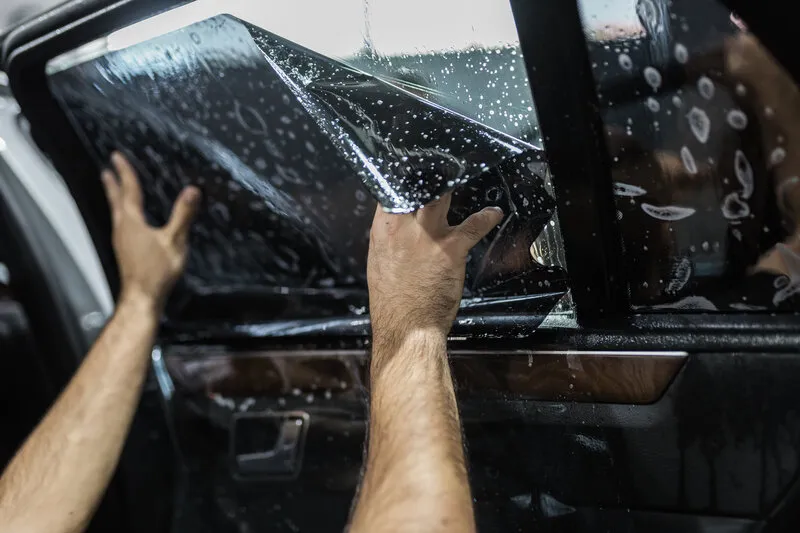
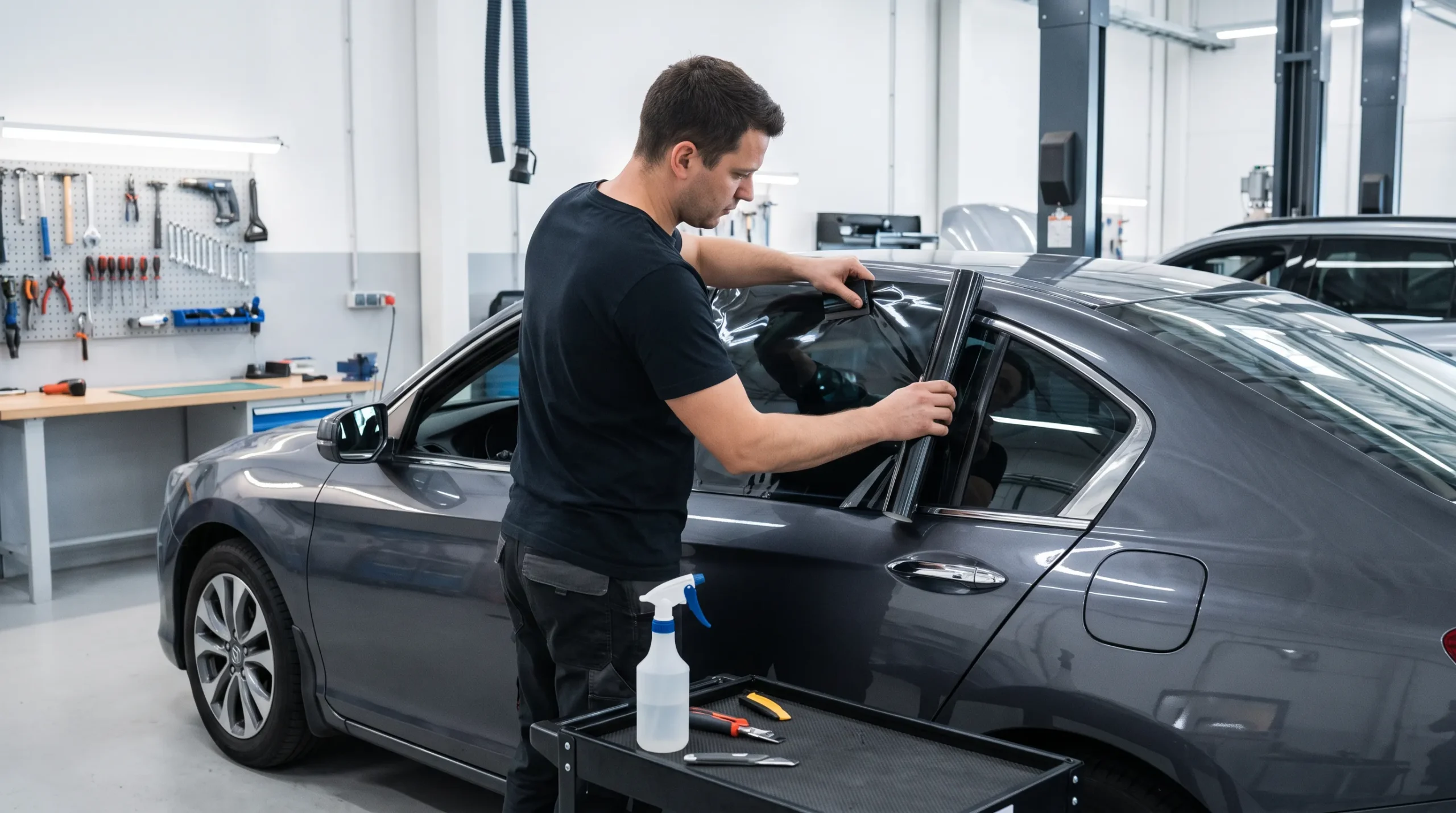
Audio Vision provides window tint installation at 5521 Holt Blvd, Montclair, CA 91763.
If you are looking for the best window tint for heat rejection, this guide explains ceramic tint, TSER, infrared measurements, VLT, California front-window rules, and what to compare before selecting film.
For motorists focused on cabin heat, the best window tint for heat rejection is usually a high-performance ceramic or multilayer optical film with strong published total solar energy rejection.
Do not judge a film using darkness alone.
Look at manufacturer specifications such as:
These measurements tell you more about the film than a salesperson simply calling it “premium ceramic.”
Current manufacturer data shows how large the differences can be between film lines.
LLumar’s March 2026 automotive specifications list ATC 35 dyed film at 35% TSER, CTX 35 ceramic film at 48% TSER, and IRX 35 infrared-rejecting ceramic film at 54% TSER when measured under the manufacturer’s stated test conditions.
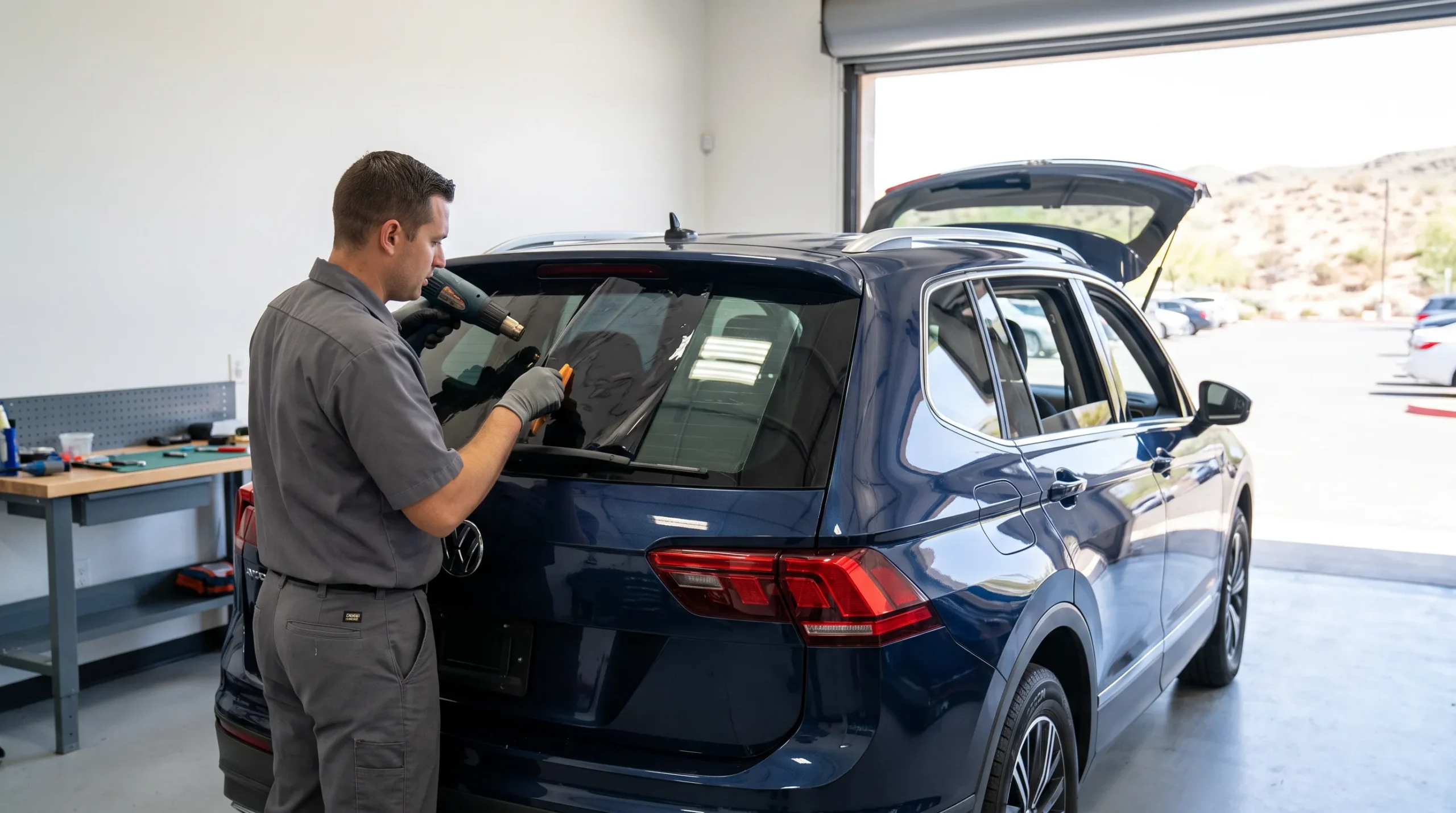
That is a useful comparison because those films sit in a similar shade range but do not have the same heat performance.
Ceramic window film uses particles designed to work with portions of solar energy without relying on a highly reflective metallic appearance.
LLumar says its ceramic products use nano-ceramic particles to reduce infrared heat and block UV radiation.
Its ceramic lineup currently includes CTX, IRX, FormulaOne Pinnacle, and FormulaOne Stratos.
3M also sells Ceramic IR film as well as its multilayer Crystalline film.
One reason motorists look for ceramic film is that you can choose heat-focused products in several shade levels.
That gives you more freedom to balance:
For an Inland Empire commuter who spends hours in the sun, film performance can matter more than simply making every window as dark as possible.
TSER stands for total solar energy rejected.
This number looks at solar energy across a wider range than a narrow infrared measurement.
If a film lists 60% TSER under a stated test method, that means the glass-and-film combination rejected 60% of the total solar energy measured under those test conditions.
TSER accounts for more than infrared light alone.
That makes it one of the most useful numbers when comparing the best window tint for heat rejection.
LLumar’s March 2026 performance sheet shows these TSER figures on its stated test glass:
The same sheet lists FormulaOne Pinnacle 35 at 55% TSER and Classic 35 at 35%.
That difference shows why film construction matters.
Infrared radiation is part of solar energy and is strongly associated with the heat people feel from sunlight.
Window-film manufacturers may publish more than one infrared number.
This can make shopping confusing.
3M distinguishes between IRER and IRR.
Its documentation describes IRER as infrared energy rejection measured across the 780-to-2,500-nanometer range while accounting for transmitted and absorbed energy that may be reradiated into the vehicle.
Its IRR figure covers a narrower 900-to-1,000-nanometer range.
LLumar also publishes IRER and another infrared measurement across its stated test ranges.
That means two products can both advertise a large “IR rejection” percentage while measuring different things.
When comparing film, ask exactly what the number represents.
If your goal is reducing overall solar heat entering the vehicle, TSER gives you a broader picture.
Infrared data is still useful, especially when comparing films tested using the same method.
The problem comes when shoppers compare one company’s narrow-band IR number against another company’s broader IRER figure and assume the larger number must mean better overall heat performance.
That is not a fair comparison.
Here’s what matters: compare the same measurement whenever possible.
A useful shopping order is:
This gives you a much clearer picture of the best window tint for heat rejection than looking at one large marketing percentage.
Not necessarily.
Darker film blocks more visible light, but visible-light darkness and solar-energy rejection are separate measurements.
Current LLumar data makes this easy to see.
FormulaOne Classic 05 is very dark at 5% VLT and lists 44% TSER.
FormulaOne Stratos 70 is much lighter at 69% VLT and lists 49% TSER.
Under those published test conditions, the much lighter Stratos 70 rejects more total solar energy than the dark Classic 05.
3M shows a similar idea with its high-performance Crystalline line, which provides substantial solar rejection across several lighter shades.
This is why asking for the darkest tint is not the same as asking for the best window tint for heat rejection.
Quite a bit, depending on the film.
LLumar’s current North American sheet lists AIR 80 at 77% VLT with 43% TSER.
Its FormulaOne Stratos 70 lists 69% VLT with 49% TSER.
3M Ceramic IR 70 is listed at 51% TSER when tested on the company’s stated automotive glass setup.
These films allow much more visible light through than dark privacy shades while still publishing meaningful solar-energy performance.
That can be useful when you want a lighter appearance or are dealing with glass where darkness is restricted.
Film availability and legal suitability still need to be checked for the exact window.
3M’s Crystalline Series is a multilayer optical film rather than a traditional dark dyed product.
The current August 2025 technical sheet says Crystalline uses more than 200 layers and rejects up to 64% of total solar energy through vehicle windows.
3M also lists:
See the 3M Crystalline Technical Data Sheet.
Crystalline is worth comparing when heat reduction matters but you do not necessarily want extremely dark glass.
3M Ceramic IR is another heat-focused option.
The manufacturer’s published data shows several shades from dark Ceramic IR 5 through lighter Ceramic IR 70.
On 3M’s stated Auto 75 test glass, the sheet lists:
3M also lists up to 99.9% UV protection and a metal-free construction.
See the 3M Ceramic IR Technical Data Sheet.
Notice that even the lighter Ceramic IR 70 retains a published TSER figure above 50% on that test setup.
LLumar IRX is an infrared-rejecting ceramic film.
LLumar describes IRX as a nano-ceramic product designed around reducing infrared heat while allowing motorists to choose from several shades.
Its March 2026 North American specifications list:
The same sheet lists 99% UV protection across the series.
For someone comparing the best window tint for heat rejection, IRX demonstrates why a ceramic series should be judged by its technical sheet rather than color alone.
FormulaOne Stratos is LLumar’s highest heat-rejection FormulaOne automotive tint line in its current product range.
LLumar’s March 2026 data lists Stratos 05 at 65% TSER and Stratos 70 at 49% TSER, with several shades between them.
Its infrared figures are also strong across the range.
LLumar states that Stratos uses a nano-ceramic construction and does not block electronic signals.
It also carries a transferable limited lifetime warranty, subject to the manufacturer’s terms.
See LLumar FormulaOne Stratos.
If maximum published solar rejection is your goal, this is the type of film data worth comparing against other premium lines available from your tint shop.
VLT stands for visible light transmission.
A 70% VLT film allows much more visible light through than a 20% VLT film.
Your choice depends on:
Do not forget that the final VLT is affected by both the film and the original glass.
A film advertised as one VLT does not guarantee that the completed window will measure at exactly the same number.
For California front side glass, this difference matters a lot.
California changed part of Vehicle Code Section 26708 effective January 1, 2026.
The current law allows qualifying clear, colorless, transparent material on the front side windows immediately beside the front seat when several requirements are met.
Among them:
Read the current California Vehicle Code Section 26708 before deciding what belongs on your front side glass.
Do not assume that a film marketed as “70%” satisfies this rule.
The statute sets an 88% minimum for the qualifying material itself under this exception.
California treats windows behind the motorist differently.
Section 26708 lists side windows behind the person operating the vehicle as an exception to the general restriction.
The rear window is also covered by an exception when the vehicle has qualifying outside mirrors on both sides as described by the statute.
That gives many vehicle owners more shade choices on rear passenger glass and the rear window.
This is where you can often choose a darker heat-rejecting film if that matches your appearance and privacy goals.
A common heat-focused plan can use suitable film on the rear glass while treating the front side windows according to the current California requirements.
Heat is not the only reason people choose window film.
3M lists up to 99.9% UV blocking for its current Crystalline line.
Its Ceramic IR data also lists up to 99.9% UV protection.
LLumar’s current IRX specifications list 99% UV protection, while FormulaOne Stratos also lists 99%.
UV performance can help reduce the amount of ultraviolet radiation passing through treated automotive glass.
It may also help reduce UV-related fading of interior surfaces.
Check the exact product specification rather than assuming every tint film provides identical UV protection.
Many current ceramic films are made without metallic construction that can interfere with radio-frequency signals.
3M states that Ceramic IR is metal-free and does not interfere with cell phones, GPS, or satellite radio.
Its Crystalline line is also non-metalized.
LLumar states that IRX and FormulaOne Stratos are designed without electronic signal interference.
This can matter in vehicles that use:
Ask about film construction when comparing heat-rejecting tint.
When asking a shop for the best window tint for heat rejection, do not stop at “What is your ceramic tint?”
Ask:
Get a product name you can verify.
This gives you a broader solar-energy measurement.
You need to know how much visible light the film allows through.
Ask whether the number is IRER, IRR, or another measurement.
Use the product sheet.
Ask what the manufacturer covers and what paperwork you receive.
Front and rear glass do not have the same rules.
These questions make it easier to compare actual film performance instead of labels.
For Inland Empire motorists, heat rejection is often a bigger concern than appearance alone.
A vehicle parked outside in Montclair, CA during summer may spend hours taking in solar energy through several large pieces of glass.
SUVs, trucks, and vehicles with large rear windows can have even more glass area exposed to sunlight.
A heat-focused tint plan can address multiple windows instead of treating the two front doors as the entire project.
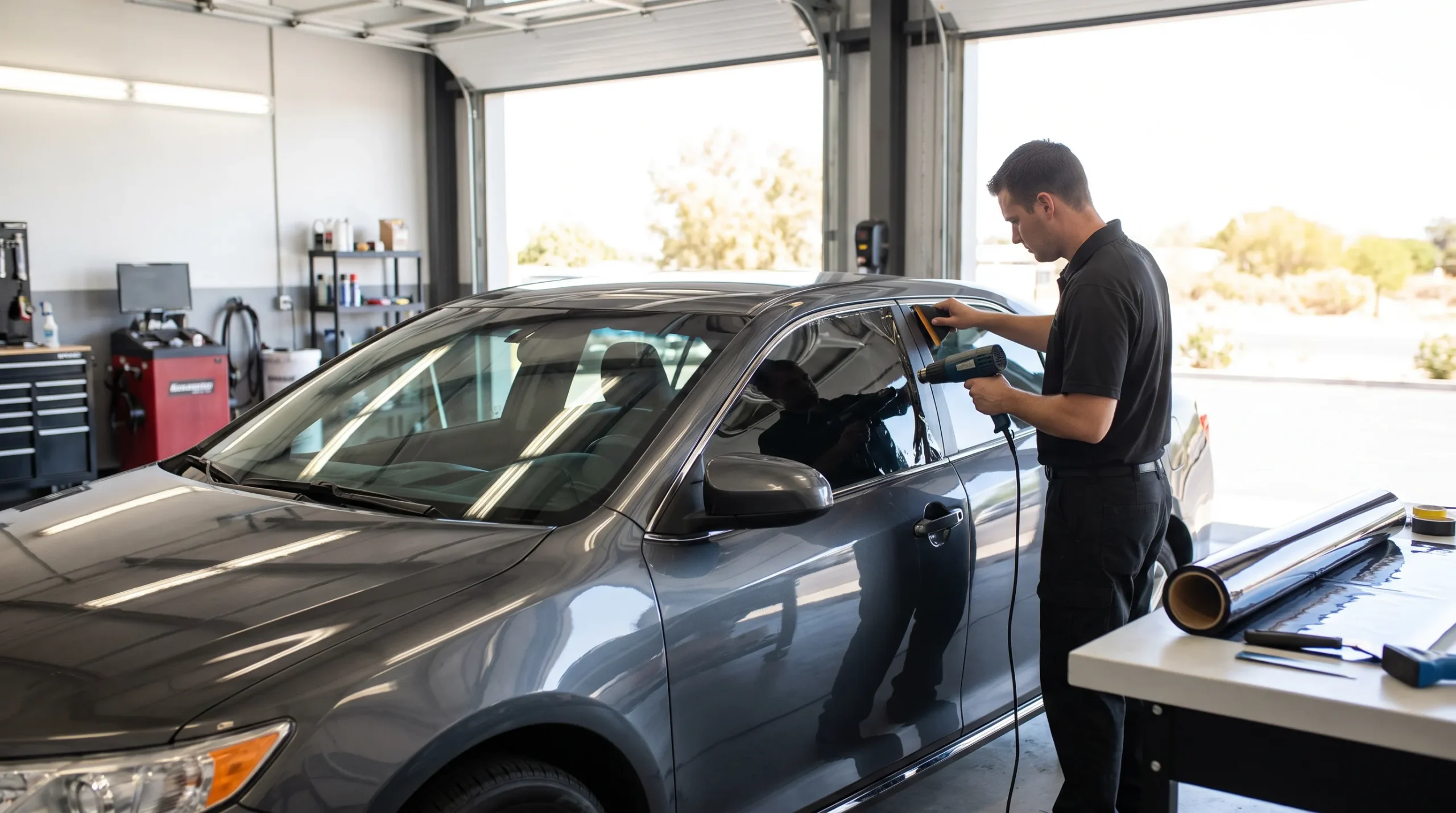
Drivers from Ontario, CA and Rancho Cucamonga, CA can visit Audio Vision for window tint installation and discuss which film and shade make sense for their vehicle.
Audio Vision can also help with related vehicle work including car audio, Apple CarPlay, car security systems, and vehicle wraps.
If you want the best window tint for heat rejection for your vehicle, start by identifying what matters most.
Tell Audio Vision:
Ask to compare the published specifications for available film before choosing.
A darker shade may suit your rear windows and privacy goals.
A lighter high-performance film may make more sense elsewhere.
The right combination depends on the vehicle, glass, California rules, and how you use the vehicle.
Audio Vision
5521 Holt Blvd
Montclair, CA 91763
Phone: (909) 983-4500
Hours: Monday through Sunday, 9 a.m. to 7 p.m.
Call (909) 983-4500 or contact Audio Vision online to discuss heat-rejecting window film and schedule an appointment.
The best window tint for heat rejection is generally a film with strong published TSER and infrared performance that also fits your desired VLT and the rules for the window being treated. High-performance ceramic and multilayer optical films are good categories to compare.
It can be. Current manufacturer data shows some ceramic films rejecting more total solar energy than darker dyed films. Compare TSER instead of judging heat performance from darkness.
Not always. LLumar’s current FormulaOne data lists dark Classic 05 at 44% TSER while the much lighter Stratos 50 lists 54% TSER under the manufacturer’s stated test conditions. Film construction matters.
TSER means total solar energy rejected. It measures the share of total solar energy rejected by the tested glass-and-film setup. It is one of the more useful figures for comparing heat-focused automotive films.
No. Infrared is one portion of solar energy. Manufacturers may also measure infrared over different wavelength ranges. TSER looks at total solar energy and gives a broader comparison.
California’s current front side-window exception in Vehicle Code Section 26708 calls for clear, colorless, transparent material with at least 88% VLT, while the finished glazing must meet the stated federal requirements including at least 70% light transmission. Other conditions also apply. Dark ceramic film does not fit that exception simply because it has good heat performance.
Audio Vision provides window tint installation at 5521 Holt Blvd, Montclair, CA 91763. Call (909) 983-4500 or use the Audio Vision contact page to discuss film choices for your vehicle.
Looking for the best car audio installation in Montclair, CA? Discover expert tips, top brands, and why Audio Vision is the go-to destination for high-quality car sound systems.
Product Brand: Audio Vision
Product Currency: USD
Product Price: 299
Product In-Stock: InStock

Acima, a flexible lease-to-own option that helps you get the car upgrades you love—without needing perfect credit. Whether you’re looking for car audio, video, security systems, window tint, wheels, auto lighting, or accessories, Acima makes it easy with no credit needed and convenient payment options. Get what you want today and pay over time, hassle-free!

Snap Finance is here to help you get the car audio, video, security, window tint, wheels, lighting, and accessories you need today. With Snap Finance, you can shop now and pay later, thanks to their flexible payment plans that consider more than just your credit score. Applying is fast and easy, and you’ll receive a decision in seconds. Take advantage of stress-free payment options that fit your payday schedule, so you can upgrade your ride without the wait!
Explore the many services we offer by clicking the boxes below


|
|
|
|
|
|
|
|
|
|
|
|
|
|
|
|
Best Window Tint for Heat Rejection in Inland Empire Summers
|
Best Window Tint for Heat Rejection in Inland Empire Summers
|
Best Window Tint for Heat Rejection in Inland Empire Summers
|
Best Window Tint for Heat Rejection in Inland Empire Summers
|
|
|
|
|
|
|
|
|
|
|
|
|
|
|
|
|
|
|
|
|
|
|
|
|
|
|