

Looking for the best car audio installation in Montclair, CA? Discover expert tips, top brands, and why Audio Vision is the go-to destination for high-quality car sound systems.
Product Brand: Audio Vision
Product Currency: USD
Product Price: 299
Product In-Stock: InStock
Advanced car security systems can do far more than sound a siren when someone opens a door. Depending on the equipment and vehicle, a modern setup can watch for impacts, vehicle tilting, glass breakage, unauthorized entry, or movement while also providing GPS location information and starter-interruption features.
The goal is layered protection. One part of the system can warn you about activity around the vehicle, another can attract attention, another can make unauthorized starting more difficult, and GPS equipment can help locate the vehicle if it is moved.
Audio Vision in Montclair, CA installs car security systems, car alarms, and GPS vehicle tracking systems for drivers who want more protection than a factory lock-and-key setup may provide. If you are comparing advanced car security systems, understanding what each layer does can help you choose a setup that fits your vehicle.
Advanced car security systems combine several types of theft-deterrent equipment rather than relying on one alarm trigger.
A system may include:
The exact combination depends on the equipment and vehicle.
The National Highway Traffic Safety Administration separates anti-theft equipment into several categories. NHTSA describes audible and visible devices, immobilizing-type devices, and vehicle recovery systems as different ways to make a vehicle harder to steal or easier to locate after theft.
Read NHTSA’s Vehicle Theft Prevention guidance.
This layered approach is useful when comparing advanced car security systems because no single feature performs every job.
A siren draws attention.
A sensor detects a type of activity.
Starter interruption can block a normal starting attempt while the security system is armed.
GPS tracking can help provide vehicle location information.

Together, those features can cover more situations than a simple factory horn alarm.
Vehicle theft does not always happen the same way.
Someone may try a door.
Someone may break a window.
A thief targeting wheels may lift one side of the vehicle.
Another attempt may involve trying to start and move the entire car.
This is why advanced car security systems can use several detection methods.
NHTSA notes that audible alarms are meant to bring attention to unauthorized attempts to enter or steal a vehicle. It also describes immobilizing devices as equipment intended to stop thieves from bypassing the ignition system, while recovery systems use electronic transmission technology to help reveal a stolen vehicle’s location.
One feature handles detection. Another handles notification. Another can affect starting. Another can help with recovery.
Here’s what matters: the security setup should match the risks you want to address.
A car with custom wheels may make tilt sensing especially worth discussing.
A vehicle parked far from the owner’s home may make two-way or phone-based alerts useful.
A driver concerned about the entire vehicle being taken may want to discuss GPS tracking and starter interruption.
GPS adds a location layer to advanced car security systems.
A compatible connected module can allow vehicle location information to appear in an app or online service. The exact functions depend on the device and service plan.
Viper’s SmartStart Pro module lists GPS vehicle tracking, remote vehicle control, status information, and alerts among its functions.
See the Viper SmartStart Pro GPS module.
GPS equipment should not be confused with a sensor that physically stops someone from entering the vehicle.
Its role is different.
A tracker can help you see where a vehicle is located or receive supported location-related information after movement occurs.
NHTSA also recommends considering a GPS tracking device when a vehicle did not come with theft-protection equipment of that type.
Audio Vision provides car tracking systems and GPS tracker installation for customers in Montclair, CA and surrounding areas.
If GPS is high on your list, tell the installer whether you also want alarm alerts, starter interruption, remote start, or door-control functions.
Sensors are what allow advanced car security systems to react to different types of activity.
The type of sensor determines what the system watches for.
Compustar’s current DAS-II security sensor detects:
You can review the Compustar DAS-II vehicle security sensor.
Not every alarm package includes every sensor.
That is why it helps to ask what a particular system actually detects rather than simply asking whether it has an alarm.
A system designed mainly to watch doors may not provide the same wheel-theft protection as one with tilt sensing.
A system with impact sensing may react differently from one equipped with glass-break detection.
The sensor package is one of the biggest differences between a simple alarm and a more complete vehicle security setup.
Shock sensors monitor impacts or disturbances to the vehicle.
Many security systems use dual-stage sensing.
Compustar describes its current security systems as using dual-stage shock detection. One level can react to a lighter impact, while a stronger event can cause a full alarm response depending on how the system is programmed.
This can help a system distinguish between different levels of disturbance.
A light bump near the vehicle does not necessarily need the same response as a stronger impact.
Sensor sensitivity also matters.
A sensor set too sensitively could respond to normal activity around the vehicle. One set too low may miss the type of event you want it to detect.
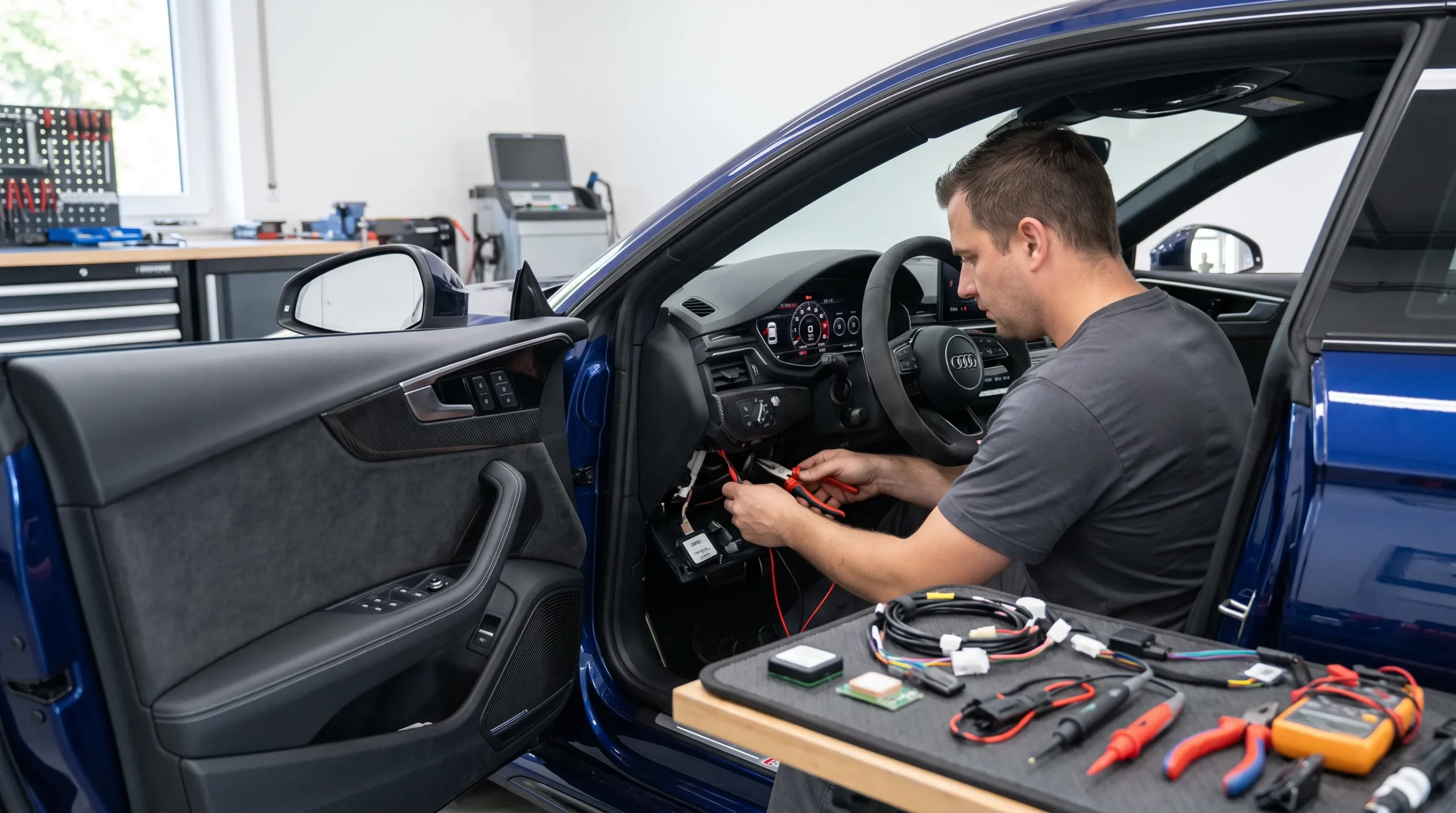
Professional setup is part of installing advanced car security systems because sensors have to work with the vehicle rather than simply being connected and forgotten.
Tilt sensing watches for a change in the vehicle’s angle.
That can be useful when someone attempts to raise the vehicle.
A thief removing wheels may use a jack to lift one corner or side of the car. A tilt sensor gives the alarm another way to detect activity that may not create a large impact first.
Compustar includes tilt detection in its DAS-II sensor and several current security packages.
If you have aftermarket wheels and rims, ask about tilt sensing when comparing advanced car security systems.
Wheel locks and careful parking habits can still be part of your overall approach, but electronic tilt sensing adds another layer to the alarm system itself.
A broken window may not always create the same type of impact as someone striking a body panel.
Glass-break sensing is designed to watch for activity associated with breaking glass.
Compustar’s DAS-II combines glass-break detection with impact, tilt, and forward-motion sensing in one sensor.
That type of multi-function sensor lets advanced car security systems watch for several events from one installed component.
Motion-related sensing can also help detect changes beyond a simple door switch.
The exact response depends on the alarm hardware and programming.
If protecting items inside the cabin is a concern, ask which sensors are supported by the system you are considering.
Doors remain one of the most common places for a security system to monitor.
An alarm can use vehicle door status information or installed trigger connections to detect unauthorized opening while the system is armed.
The hood and trunk can also be monitored when the vehicle and security setup support those connections.
Hood protection deserves attention because many alarm components and vehicle electrical parts are located under the hood.
A trunk trigger can protect access to cargo and audio equipment installed in the rear of the vehicle.
Customers with car amplifiers or a car subwoofer may want to discuss trunk protection when planning advanced car security systems.
Audio Vision also offers car door-lock services for drivers working on vehicle access and security functions.
Starter kill, sometimes called starter interruption, is designed to stop the starter from operating while the aftermarket security system is armed.
Compustar describes its E-LOCK starter-kill relay as a feature that disables the starter until the security system is disarmed.
Read more on the Compustar car alarm features page.
Viper security products also list starter interrupt as a security feature on current systems such as its 3103V and 3308V.
Starter interruption does not mean a vehicle can never be stolen.
Security products should not be treated as a guarantee against theft.
Instead, the feature adds another obstacle by interfering with a normal starter circuit while the security system remains armed.
When discussing advanced car security systems, ask how the starter-interruption feature works with your particular vehicle, especially if it uses push-button start or factory anti-theft electronics.
An immobilizer is a theft-deterrent system designed to prevent unauthorized vehicle starting.
NHTSA describes immobilizing-type devices as systems that make it harder to bypass the ignition and hot-wire a vehicle. Some use computer chips in keys, while others can interrupt electricity or fuel needed for engine operation.
Many newer vehicles already have factory immobilizer technology.
The owner may not interact with it beyond using the correct key or key fob.
NHTSA advises owners whose vehicles have immobilizers to lock the vehicle with the key fob so the system can be used as intended.
An aftermarket starter-kill feature and a factory engine immobilizer are not always the same thing.
They may both affect whether the vehicle can start, but they can work through different hardware and control methods.
That distinction matters when comparing advanced car security systems.
A factory immobilizer does not mean there is nothing else you can add to a vehicle.
It handles one part of theft protection.
You may still want:
An aftermarket security system can sometimes work alongside factory electronics when compatible equipment and installation methods are used.
Compustar states that some of its alarm packages can be paired with vehicle interface equipment to work with a car’s original alarm while adding features such as shock and tilt sensing and starter kill.
If your car already has an immobilizer, tell Audio Vision when asking about car security system installation.
The installer can look at what the vehicle already has before discussing which added security features make sense.
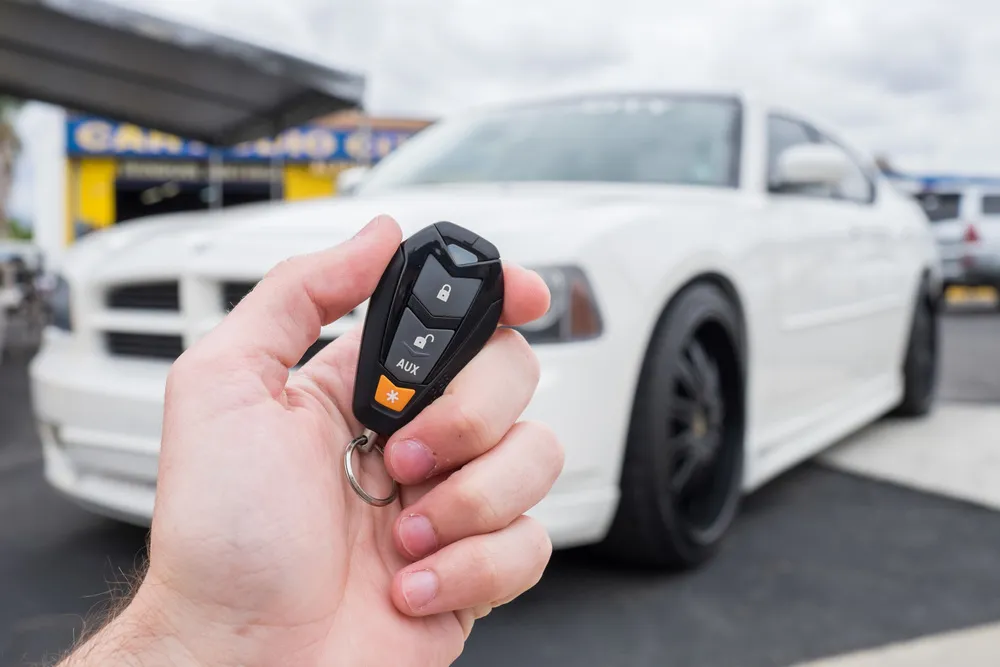
Alarm remotes generally fall into one-way and two-way categories.
A one-way remote sends a command to the vehicle.
A two-way remote can send commands and receive supported confirmation or alarm information back from the system.
Compustar’s CS8910-A security package uses a two-way LCD remote and states that the remote can notify the user when the alarm is triggered.
That can be helpful when the car is parked out of sight but still within the supported communication range.
A siren may be difficult to hear from inside a building.
A two-way remote gives advanced car security systems another notification method.
When choosing between remote types, think about where you park most often and whether feedback from the security system matters to you.
Some vehicle security systems can use cellular-connected modules to communicate with a smartphone.
Viper SmartStart Pro lists vehicle status, alerts, remote locking and unlocking, security control, and GPS-related functions.
Compustar also offers connected functions through compatible DroneMobile equipment.
Phone-based security can be useful when you want information beyond the range of a traditional key-fob remote, subject to the connected hardware, cellular service, app, and subscription requirements.
Before choosing connected advanced car security systems, ask about:
Features vary by product, so check the exact module rather than assuming every connected alarm supports the same controls.
Yes, many aftermarket systems combine vehicle security with remote start.
Compustar and Viper both offer current products that pair security functions with remote-start controls.
The exact setup depends on the vehicle.
A push-button-start vehicle, traditional key vehicle, manual-transmission vehicle, hybrid, or vehicle with complex factory electronics may call for different equipment and installation steps.
If remote start is part of what you want, mention it when planning advanced car security systems rather than adding it as an afterthought.
The installer can then look at security, starting, factory electronics, and remote-control needs as one project.
There is no single security setup that fits every car and owner.
Start by deciding what you are trying to protect against.
Ask about door triggers, impact sensors, glass-break sensing, sirens, and alerts.
Ask about tilt sensing along with physical wheel-security measures.
Ask about starter interruption, the vehicle’s factory immobilizer, GPS tracking, and connected alerts.
Consider two-way remotes or compatible smartphone notification systems.
Ask about a GPS-connected module and any service plan needed to use its features.
Look at systems designed to handle both functions with compatible vehicle hardware.
The best advanced car security systems are built around the vehicle and the owner’s concerns rather than adding every available accessory without a reason.
Audio Vision carries security brands that include Compustar, Viper, Avital, and Directed.
Audio Vision installs advanced car security systems at 5521 Holt Blvd, Montclair, CA 91763.
The shop serves drivers from Montclair, CA and nearby communities including Ontario, CA and Rancho Cucamonga, CA.
A customer with custom wheels may want impact and tilt detection.
Someone who parks at work for long periods may prefer two-way alarm alerts.
Another driver may be looking for GPS tracking and smartphone vehicle information.
An older car may need an aftermarket alarm because its factory theft equipment is limited.
Each vehicle calls for its own security plan.

Audio Vision has served the Inland Empire since 2006 and specializes in mobile electronics installation. Related services include car alarms, vehicle security systems, GPS trackers, and car door locks.
If you are comparing advanced car security systems, start by telling Audio Vision what you want the system to watch for and how you want to be notified.
Have your vehicle year, make, model, and trim ready.
You can also mention whether the vehicle has:
Then describe the features you want, such as GPS tracking, tilt sensing, impact sensing, two-way alerts, smartphone control, or starter interruption.
Audio Vision
5521 Holt Blvd
Montclair, CA 91763
Phone: (909) 983-4500
Hours: Monday through Sunday, 9 a.m. to 7 p.m.
Call (909) 983-4500 or contact Audio Vision online to discuss car security equipment and schedule an installation appointment.
Advanced car security systems can use compatible sensors to watch for impacts, vehicle tilt, glass breakage, movement, door opening, hood opening, or trunk opening. Available detection depends on the security hardware installed.
A security system with tilt sensing can detect changes in vehicle angle associated with lifting the car. Compustar offers current sensors with tilt detection. If protecting aftermarket wheels is a concern, ask Audio Vision about tilt sensing when choosing your alarm setup.
GPS tracking is mainly a vehicle-location and recovery feature rather than a physical barrier against entry. NHTSA lists vehicle recovery systems separately from immobilizing and audible anti-theft devices. A layered setup may combine GPS with alarms, sensors, and starter interruption.
Starter kill is commonly an aftermarket alarm feature that interrupts the starter while the security system is armed. A factory immobilizer is built into the vehicle and may use a coded key, transponder, or other factory electronics to prevent unauthorized starting.
Some connected security systems can. Compatible Viper SmartStart equipment, for example, supports smartphone vehicle status, controls, alerts, and GPS-related features. Cellular-connected features may require compatible hardware and a service plan.
Yes. Current Compustar and Viper product lines include systems that combine remote-start and security functions. Vehicle compatibility should be checked before equipment is selected.
Audio Vision installs car security systems, car alarms, and GPS trackers at 5521 Holt Blvd, Montclair, CA 91763. Call (909) 983-4500 or use the Audio Vision contact page to schedule an appointment.
Looking for the best car audio installation in Montclair, CA? Discover expert tips, top brands, and why Audio Vision is the go-to destination for high-quality car sound systems.
Product Brand: Audio Vision
Product Currency: USD
Product Price: 299
Product In-Stock: InStock

Acima, a flexible lease-to-own option that helps you get the car upgrades you love—without needing perfect credit. Whether you’re looking for car audio, video, security systems, window tint, wheels, auto lighting, or accessories, Acima makes it easy with no credit needed and convenient payment options. Get what you want today and pay over time, hassle-free!

Snap Finance is here to help you get the car audio, video, security, window tint, wheels, lighting, and accessories you need today. With Snap Finance, you can shop now and pay later, thanks to their flexible payment plans that consider more than just your credit score. Applying is fast and easy, and you’ll receive a decision in seconds. Take advantage of stress-free payment options that fit your payday schedule, so you can upgrade your ride without the wait!
Explore the many services we offer by clicking the boxes below


|
|
|
|
|
|
|
|
|
|
|
|
|
|
|
|
Advanced Car Security Systems: GPS Tracking, Sensors & Immobilizers
|
Advanced Car Security Systems: GPS Tracking, Sensors & Immobilizers
|
Advanced Car Security Systems: GPS Tracking, Sensors & Immobilizers
|
Advanced Car Security Systems: GPS Tracking, Sensors & Immobilizers
|
|
|
|
|
|
|
|
|
|
|
|
|
|
|
|
|
|
|
|
|
|
|
|
|
|
|