
Looking for the best car audio installation in Montclair, CA? Discover expert tips, top brands, and why Audio Vision is the go-to destination for high-quality car sound systems.
Product Brand: Audio Vision
Product Currency: USD
Product Price: 299
Product In-Stock: InStock
Harley-Davidson audio upgrades need to solve a problem that car stereos do not face: your music has to compete with wind, exhaust, tire noise, a helmet, and an open riding environment. A speaker that sounds fine with the motorcycle parked can become difficult to hear once you reach freeway speed.
That is why replacing fairing speakers alone is not always the answer.
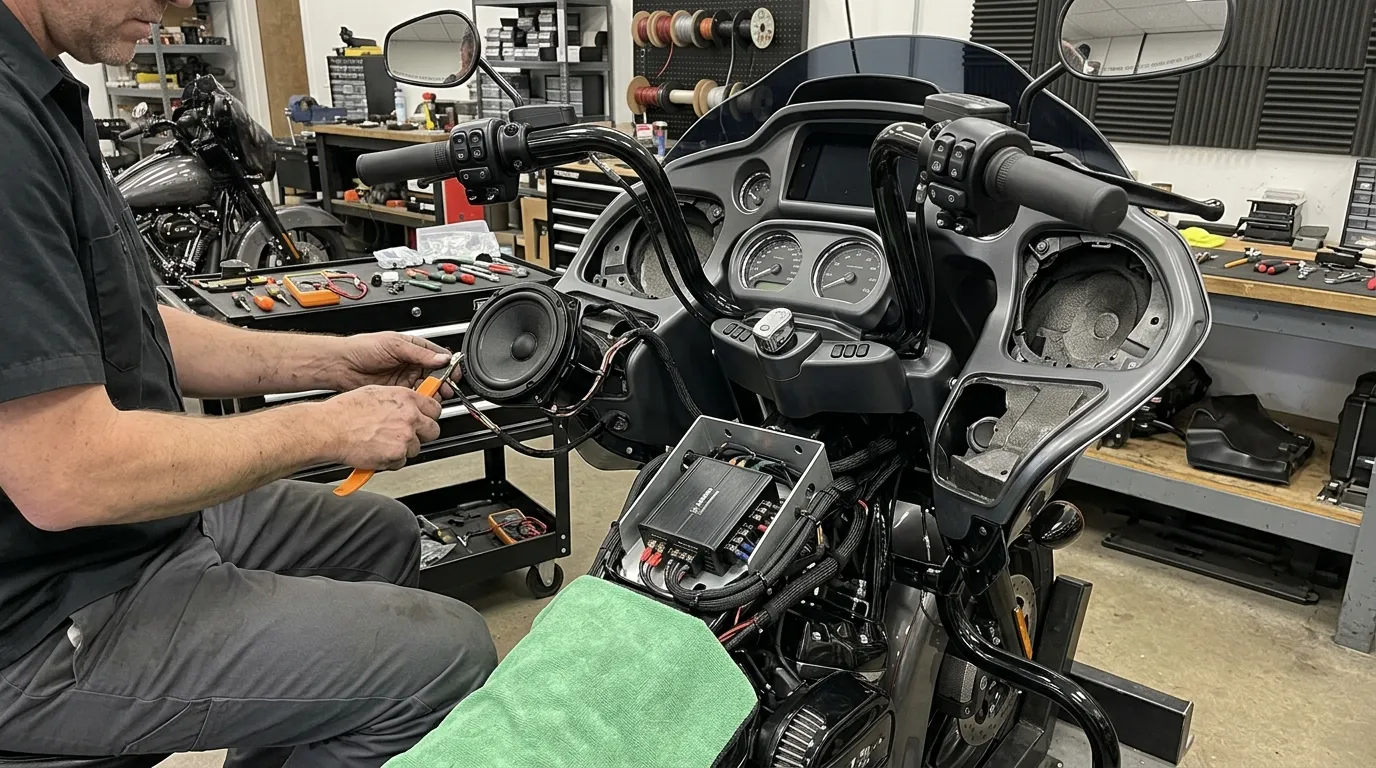
The best Harley audio builds usually treat the fairing speakers, amplifier, factory radio, handlebar controls, wiring, charging system, weather exposure, and tuning as parts of the same system.
Current motorcycle-specific kits from KICKER and Rockford Fosgate show this approach clearly. Both companies offer Harley-Davidson systems built around weather-resistant speakers, compact amplifiers, model-specific mounting hardware, and wiring made for motorcycle use.
Some Harley models also need radio programming after an aftermarket amplifier is added. Getting that detail wrong can affect sound quality and speaker reliability.
For riders in Montclair, CA, Ontario, CA, and Pomona, CA, this guide explains what to look at before changing your Harley’s audio system and which upgrades can make the biggest audible difference.
Audio Vision provides motorcycle audio installation from its Montclair, CA shop and works with riders throughout the Inland Empire.
A motorcycle stereo operates in an open environment.
There is no roof, windshield glass, door panel, or enclosed cabin holding the music around you.
Once the bike starts moving, the speakers compete with:
KICKER states that its Harley-Davidson fairing systems are built to remain clear over road and wind noise. Rockford Fosgate makes a similar point with its Harley-specific kits, which are designed to produce enough output for riding conditions rather than only sounding good while parked.
That changes how speakers need to be chosen.
A mild factory replacement may improve a damaged speaker but still fall short at freeway speeds.
A properly planned Harley system may need higher-output fairing speakers paired with an amplifier designed for motorcycle use.
The bike also has much less space for electronics than a car.

That makes compact amplifier size, mounting brackets, wiring paths, current draw, and heat management part of the decision.
Do not buy motorcycle audio equipment based only on speaker diameter.
Start with:
KICKER currently lists different Harley audio kits for specific ranges, including:
Rockford Fosgate also offers Harley-specific systems built around model year and speaker location.
That matters because fairing design, speaker mounting points, factory amplifiers, and radio configuration can change between generations.
A kit designed for a 2015 Road Glide should not be treated as a universal Harley audio kit.
The front fairing speakers are usually the first place riders look when planning Harley-Davidson audio upgrades.
That makes sense.
The fairing speakers point toward the rider and create most of the front sound.
KICKER’s current Harley fairing kits use weather-resistant 6.5-inch coaxial speakers in several applications. Its HDS144 kit for 2014-2023 Street Glide, Electra Glide, and Ultra Glide models uses 2-ohm 6.5-inch speakers paired with a compact amplifier.
Its HDR154 kit takes a similar approach for 2015-2023 Road Glide models.
Rockford Fosgate’s current Harley systems also use 6.5-inch fairing speakers in several kits.
A new fairing speaker can improve:
Still, a speaker has to be matched to the amplifier.
Replacing a factory speaker with one designed for much more power while keeping weak factory power may not produce the change you expect.
A Harley speaker lives in a tougher environment than a typical car door speaker.
Motorcycles face:
KICKER describes the coaxial speakers in its Harley kits as weather-proof and uses polypropylene woofer cones designed to resist moisture.
Rockford Fosgate says its Harley kit components are tested against water exposure, temperature changes, vibration, and UV exposure. The company also uses corrosion-resistant hardware and weather-focused materials in its motorcycle products.
That is why installing ordinary indoor speakers or equipment not intended for powersports use can be a poor choice.
The speaker might physically fit, but that does not mean it was built for a motorcycle environment.
Speakers only produce the output that the rest of the system allows.
A higher-output motorcycle speaker paired with suitable amplifier power can maintain cleaner sound at higher riding volume than a speaker running from limited radio power.
KICKER’s HDS144 and HDR154 Harley kits pair their fairing speakers with compact four-channel amplifiers rated at 75 watts RMS per channel at 2 ohms.
The amplifier is not an afterthought in those kits.
It is part of the system.
Rockford Fosgate also packages amplifiers with many Harley-specific systems.
A motorcycle amplifier can help provide:
Audio Vision offers motorcycle audio installation for riders who want speakers and amplifiers planned together.
Motorcycle amplifier placement needs more thought than car amplifier placement.
There is less room, and the amplifier needs to deal with vibration, heat, and weather exposure.
Motorcycle-specific Harley kits often include mounting brackets designed for a particular fairing.
KICKER’s Harley kits include compact amplifiers and custom-fit amp brackets.
Rockford Fosgate also includes model-specific amplifier mounting hardware with certain Harley packages.
The amplifier may be mounted:
Where it belongs depends on the bike and system.
Heat also matters.
Rockford Fosgate notes that its fairing-mounted amplifiers depend on appropriate airflow around the heat sink. Wiring should not be packed around the amplifier in a way that traps heat.
The amplifier also needs to be secured firmly.
Motorcycles vibrate far more than parked home-audio equipment.
Loose mounting hardware can create rattles and can expose the amplifier to unnecessary movement.
An audio upgrade does not automatically mean replacing your factory Harley radio.
KICKER specifically designs several Harley systems to work with the factory radio.
Its motorcycle fairing kits use model-specific wiring harnesses and are designed to retain the original radio rather than requiring a replacement head unit.
That can preserve the factory appearance.
It can also keep the controls riders already know.
A factory-radio build may include:
Larger builds can then add rear speaker locations.
Keeping the factory source can make sense when you like the Harley interface but want more sound at speed.
This is one of the details riders can easily miss.
Adding an amplifier to certain Harley factory radios may require radio programming.
KICKER states that its 2015-and-newer Road Glide front speaker and amplifier kit should be paired with radio programming for proper operation.
The company recommends using a motorcycle shop with compatible infotainment programming software or its applicable programming method.
Rockford Fosgate also says many 2014-2023 Harley models with factory Boom! Box radios need a firmware update or flash when an aftermarket amplifier is installed.
Rockford Fosgate warns that skipping required radio setup can produce poor audio output and create speaker reliability problems.
So, before adding an amplifier, ask:
Do not assume an amplifier is finished once the wires are connected.
Factory bar controls are a big part of the riding experience.
Nobody wants to reach toward the fairing every time the volume needs to change.
On factory-equipped bikes, bar controls may handle:
When the factory radio stays in place, compatible model-specific speaker and amplifier kits can often leave the original bar-control arrangement intact because the radio itself is not being replaced.
That is one reason KICKER promotes factory-radio use with its Harley systems.
If you are replacing the factory radio with an aftermarket receiver, control retention becomes a separate question.
The installer needs to check whether the replacement radio and adapter hardware support the Harley controls you want to keep.
Do not assume every aftermarket source works with every factory button.
Tell the installer that handlebar control retention is part of the project before equipment is selected.
A Street Glide and Road Glide may share some audio goals, but the fairings are different.
KICKER separates its Harley kits accordingly.
Its HDS144 kit fits selected 2014-2023 Street Glide, Electra Glide, and Ultra Glide fairings.
Its HDR154 kit is built for selected 2015-2023 Road Glide “Shark-Nose” fairings.
That model-specific fit affects:
This is why you should give the installer the exact model year and trim instead of only saying, “I have a Harley.”
CVO models may also have different factory amplifier and speaker layouts.
Rockford Fosgate’s Harley amplifier documentation shows that some CVO systems use multiple factory amplifiers in the fairing and saddlebags.
Those configurations need to be identified before changing the system.
Saddlebag speakers can add another pair of sound sources behind the rider.
This can increase overall output and help fill the space around rider and passenger.
Rockford Fosgate currently offers Harley systems that combine fairing speakers with 6×9-inch saddlebag speakers and a four-channel amplifier.
Its HD14-STG3 system uses:
Some bag-lid systems require modification to the saddlebag lids.
Others use replacement or purpose-built lids.
This is not the same as placing loose car speakers into a saddlebag.
The speaker mount needs to remain secure while the bike is moving, and the bag still needs to deal with weather exposure and vibration.
If you use the saddlebags for storage, discuss that too.
Speaker hardware and amplifier placement can affect usable bag space.
Tour-Pak audio can make sense on touring bikes that regularly carry a passenger.
KICKER sells rear speaker and amplifier kits for selected Harley touring models with rear speaker pods.
Rockford Fosgate also offers Tour-Pak speaker options in Harley-specific systems.
Rear speakers can help when:
The amplifier needs enough channels and suitable power for the added speakers.
This is where planning the final system before buying the first pair of speakers can save trouble.
If you know you eventually want fairing, saddlebag, and Tour-Pak speakers, tell the installer from the start.
Channel count depends on the number of speaker locations.
A simple front-fairing system may only need two powered channels.
A larger setup can use four or more.
One layout might be:
Another build may add Tour-Pak speakers and need a different amplifier plan.
The amplifier also needs to match the speaker impedance and RMS power range.
Do not select a motorcycle amplifier based only on the largest wattage number shown on the packaging.
Look at:
Loudness alone does not solve every problem.
For music to remain understandable at road speed, the system needs usable output in the frequencies that carry vocals, guitars, drums, and other musical detail.
KICKER describes its Harley speaker kits as designed to stay clear over road and wind noise.
Rockford Fosgate makes the same road-speed goal a major part of its Harley kits.
Several factors affect the result:
A speaker that can produce more output from available power can be useful on a motorcycle.
Suitable amplifier power helps keep the speakers from sounding strained as volume rises.
Fairing speakers point toward the rider rather than sending sound randomly around the bike.
Gain and crossover settings affect how cleanly the speakers operate.
Harley-Davidson’s own handlebar speaker instructions note that a windshield can improve perceived sound quality in certain applications.
The system has to work in the riding environment, not only in a quiet shop.
Every amplifier draws electrical current.
A motorcycle has less charging headroom than many cars and trucks.
That makes amplifier current draw part of the system plan.
KICKER points to low current draw as a feature of its Harley-specific amplifier systems.
A larger build with several amplifiers and many speakers can place more demand on the bike.
Before planning a large system, check:
Heated gear, lighting, phone charging, and other accessories can also be drawing power while the motorcycle is running.
This does not mean you need to avoid amplification.
It means amplifier size should make sense for the bike.
Before leaving your motorcycle with an installer, ask questions tied to your bike.
Model year matters.
Ask about moisture, UV exposure, and vibration.
A secure location matters.
Many Harley-specific systems allow it.
Make this part of the equipment plan.
Certain Harley radio and amplifier combinations do.
Know what each stage includes.
Planning for later expansion can affect the amplifier choice now.
Harley-Davidson’s own installation documentation warns that wiring must not interfere with steering movement. Harnesses should remain free when the bars are turned fully in either direction.
The bike should be checked from full left lock to full right lock after work around the handlebar or fairing area.
If you are planning Harley-Davidson audio upgrades in the Inland Empire, Audio Vision offers motorcycle audio installation from its Montclair, CA location.
A Harley audio project can include:
Audio Vision also works with established car and powersports audio manufacturers, including Rockford Fosgate and Kicker.
The shop is located at:
Audio Vision
5521 Holt Blvd
Montclair, CA 91763
Phone: (909) 983-4500
Hours: Monday through Sunday, 9:00 AM to 7:00 PM
Audio Vision serves riders from Montclair, CA, Ontario, CA, Pomona, CA, Rancho Cucamonga, CA, Chino, CA, Chino Hills, CA, Claremont, CA, and nearby Inland Empire communities.
Have your Harley’s year, model, trim, factory radio, and current speaker layout ready when you contact the shop.

Call (909) 983-4500 or contact Audio Vision online to discuss your bike and schedule an appointment.
Fairing speakers and a properly matched motorcycle amplifier are common starting points because the front speakers provide most of the sound reaching the rider. The best first change still depends on the bike’s current radio, factory amplifier, and speaker condition.
Not every replacement speaker requires a separate amp, but many higher-output motorcycle speakers are designed to work with more power than a factory radio alone provides. KICKER and Rockford Fosgate both sell Harley-specific packages that pair fairing speakers with compact amplifiers.
Yes, many model-specific motorcycle systems are built to work with the factory Harley radio. KICKER currently offers several Harley kits that retain the factory source. Compatibility depends on the model and year.
They can when the factory radio remains and the installed equipment is compatible with the existing system. If the radio itself is being replaced, control retention needs to be checked against the new receiver and adapter hardware before installation.
Some factory Harley radios use audio settings intended for the original amplifier and speakers. KICKER and Rockford Fosgate both state that certain Harley applications need radio programming after an aftermarket amplifier is added so the new system receives the appropriate output.
Yes. Harley-specific saddlebag speaker systems are available. Rockford Fosgate offers systems with 6×9-inch bag speakers for selected models. Installation may involve bag-lid modifications or purpose-built speaker mounting hardware.
Audio Vision provides motorcycle audio installation at 5521 Holt Blvd, Montclair, CA 91763. Call (909) 983-4500 or use the Audio Vision contact page to discuss fairing speakers, amplifiers, handlebar controls, saddlebag audio, and your Harley model.
Looking for the best car audio installation in Montclair, CA? Discover expert tips, top brands, and why Audio Vision is the go-to destination for high-quality car sound systems.
Product Brand: Audio Vision
Product Currency: USD
Product Price: 299
Product In-Stock: InStock

Acima, a flexible lease-to-own option that helps you get the car upgrades you love—without needing perfect credit. Whether you’re looking for car audio, video, security systems, window tint, wheels, auto lighting, or accessories, Acima makes it easy with no credit needed and convenient payment options. Get what you want today and pay over time, hassle-free!

Snap Finance is here to help you get the car audio, video, security, window tint, wheels, lighting, and accessories you need today. With Snap Finance, you can shop now and pay later, thanks to their flexible payment plans that consider more than just your credit score. Applying is fast and easy, and you’ll receive a decision in seconds. Take advantage of stress-free payment options that fit your payday schedule, so you can upgrade your ride without the wait!
Explore the many services we offer by clicking the boxes below


|
|
|
|
|
|
|
|
|
|
|
|
|
|
|
|
Harley-Davidson Audio Upgrades: Fairing Speakers, Amps & Bar Controls
|
Harley-Davidson Audio Upgrades: Fairing Speakers, Amps & Bar Controls
|
Harley-Davidson Audio Upgrades: Fairing Speakers, Amps & Bar Controls
|
Harley-Davidson Audio Upgrades: Fairing Speakers, Amps & Bar Controls
|
|
|
|
|
|
|
|
|
|
|
|
|
|
|
|
|
|
|
|
|
|
|
|
|
|
|