
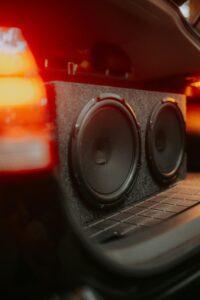
Looking for the best car audio installation in Montclair, CA? Discover expert tips, top brands, and why Audio Vision is the go-to destination for high-quality car sound systems.
Product Brand: Audio Vision
Product Currency: USD
Product Price: 299
Product In-Stock: InStock
Boat audio near me searches should lead to a system built for water, sun, vibration, wind, and corrosion, not car audio equipment placed inside a boat. Marine sound systems face conditions that vehicle electronics rarely see, including salt air, spray, direct sunlight, humidity, constant vibration, and long wire runs between batteries, amplifiers, speakers, and helm controls.
Those conditions change nearly every part of the installation.
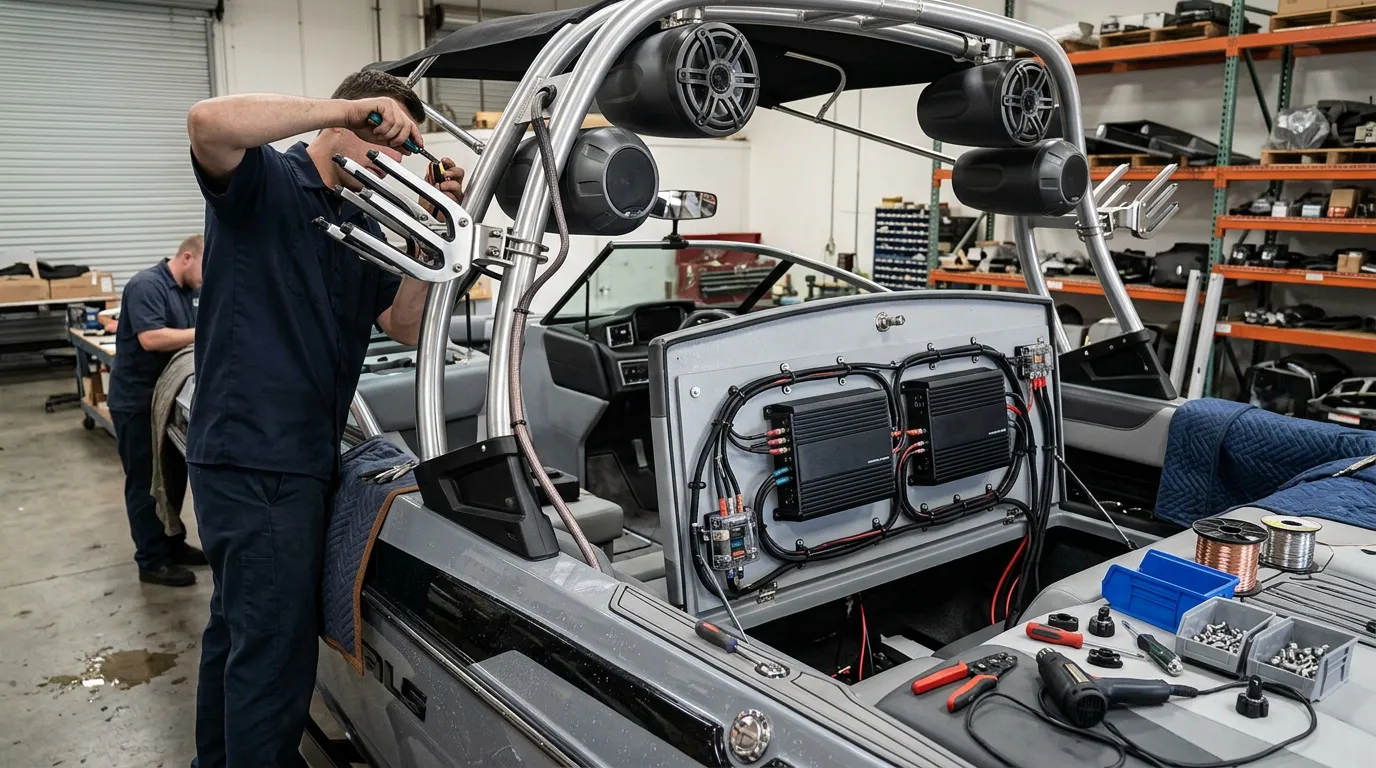
Tower speakers need to project sound across an open boat. Marine amplifiers need protection against moisture and corrosion. Power and speaker wiring should be designed for marine use. Connections need protection against water intrusion, and any holes made through the boat need to be sealed correctly.
For boat owners in Montclair, CA, Ontario, CA, and Pomona, CA, the equipment is only half the job. The way it is mounted and wired can have a major effect on how long it works.
Audio Vision provides boat audio installation for customers who want speakers, subwoofers, amplifiers, source units, and marine wiring planned as one system.
A car gives speakers an enclosed cabin.
A boat does not.
Sound from a boat speaker has to compete with wind, engine noise, waves, people moving around the deck, and a large open space where sound can escape in every direction.
Rockford Fosgate notes that marine speakers need enough output to remain clear in open-air conditions where there are no walls or roof to reflect the sound back toward the listener.
That alone can change how many speakers and how much amplifier power make sense.
The environment creates another problem.
Boat audio equipment may face:
A standard automotive speaker can sound fine at first and still deteriorate much faster once exposed to those conditions.

That is why a boat audio near me search should focus on installers who understand marine electronics rather than shops that treat every audio job like a car installation.
Marine equipment is built with materials intended to tolerate life around water.
Rockford Fosgate describes marine speakers with features such as UV-resistant cones, sealed parts, corrosion-resistant hardware, weather-resistant surrounds, and protective construction around internal components.
Its Element Ready marine amplifiers also use corrosion-resistant terminals, UV-resistant finishes, and coated circuit boards designed to reduce damage from moisture and oxidation.
West Marine makes a similar distinction between standard and marine equipment.
A marine audio system may use:
A product should not be called suitable for a boat merely because its grille can handle a splash.
Look at the protection built into the speaker, amplifier, wiring, connectors, and hardware.
Audio Vision works with marine-capable audio manufacturers including Rockford Fosgate and JL Audio.
Tower speakers and cockpit speakers serve different jobs.
Cockpit speakers are generally mounted into panels around seating and passenger areas.
They may point toward:
Tower speakers are mounted higher and are designed to throw sound farther across an open area.
This can make them useful on wake boats, ski boats, and boats where people want music to carry beyond the immediate seating area.
The difference is not simply mounting height.
Tower speakers may be designed to produce stronger output over distance because the listener may be much farther away than someone sitting next to a normal cockpit speaker.
A boat that is mainly used for quiet cruising may not need the same tower configuration as a boat used for wakeboarding.
Tower speakers make the most sense when you want sound projected beyond the normal seating area.
That can include boat owners who:
If everyone normally sits close to the cockpit speakers, adding more properly placed in-boat speakers may make more sense than installing tower pods.
The real question is where you want the music to be heard.
A boat audio installer should ask that before choosing equipment.
A system designed for people sitting at the helm is different from a system expected to reach a rider behind the boat.
Tower speaker direction matters.
A powerful speaker pointed toward empty water does little for passengers.
The installer needs to think about:
The tower structure also needs to support the speaker hardware securely.
Boat movement creates constant vibration.
A loose speaker pod can rattle, rotate, damage wiring, or become unsafe.
Wiring should also be routed so it does not rub against sharp metal or moving tower parts.
A clean installation should look planned into the boat rather than added as an afterthought.
A marine amplifier provides the power needed for a larger boat audio system.
This becomes especially useful when the system includes:
Open-air listening usually demands more speaker output than listening inside a closed vehicle.
Rockford Fosgate notes that matching marine speakers with suitable amplifier power can help maintain clear sound across the boat.
Marine amplifier construction matters too.
Rockford Fosgate’s M2 marine amplifier line uses protective circuit-board coating, corrosion-resistant zinc-nickel plated brass terminals, and UV-resistant finishes for use in high-humidity environments.
That is a very different environment from an amplifier mounted in the trunk of a sedan.
A boat amplifier should be mounted where it receives protection from direct water while still having the ventilation required by its design.
The answer depends on the number of speakers and how you want to control them.
A smaller setup might have:
A larger setup might use:
Another option is a multi-channel amplifier that can handle several speaker locations from one chassis.
Channel layout becomes even more useful when the boat has separate listening zones.
You may want the tower speakers louder while someone sitting near a cockpit speaker wants lower volume.
That is why the system layout should be planned before the amplifiers are selected.
Bass behaves differently on a boat because the listening space is open.
There is no passenger cabin trapping low-frequency energy around the listeners.
A marine subwoofer can fill in the low end that smaller cockpit and tower speakers cannot reproduce with the same authority.
Rockford Fosgate recommends paying attention to subwoofer placement because location can affect how much bass reaches the listening area.
The woofer also needs to be matched to:
Some marine subwoofers can work in infinite-baffle installations.
Others are designed for an enclosure.
Do not assume a car subwoofer box can simply be placed under a boat seat.
Moisture, mounting, enclosure material, drainage, and corrosion all need to be considered.
This is one of the largest differences between a proper marine installation and a car-style installation on a boat.
West Marine recommends tinned copper marine wire because bare copper is more vulnerable to corrosion in salt air and damp environments.
Tinning places a protective layer of tin around the copper strands.
That helps the wire resist oxidation.
Boat wiring also needs flexibility because vessels flex and vibrate while underway.
West Marine notes that stranded marine conductors handle that movement better than rigid conductors.
Marine wiring should be considered for:
Do not spend heavily on marine speakers and amplifiers only to connect them with wire that was never intended for the environment.
Connections are common trouble spots in marine electrical systems.
West Marine states that corrosion at terminals can increase resistance and cause heat, voltage loss, and intermittent equipment operation.
For audio equipment, that can show up as:
Marine-grade heat-shrink terminals can help seal the connection against moisture.
West Marine recommends tinned connectors with adhesive-lined heat shrink where moisture may be present.
Connections should also be mechanically secure.
A twisted wire covered with electrical tape is not the same thing as a properly crimped marine connection.
Boat vibration can loosen weak connections over time.
Amplifiers can draw a large amount of current.
The wire supplying that current has to be sized for both the load and the distance.
ABYC lists E-11 as its standard covering AC and DC electrical systems on boats.
West Marine also points to ABYC E-11 when discussing conductor size, circuit length, and current load.
Long wire runs create more voltage drop than short ones.
That matters on a boat because batteries and amplifiers may be located a considerable distance apart.
The system also needs proper overcurrent protection.
West Marine recommends fuses or breakers for marine electrical circuits and emphasizes careful planning for high-current wiring.
A good installer should be able to explain:
These are electrical questions, not cosmetic details.
Every new hole in a boat deserves attention.
West Marine warns that a small unsealed penetration can allow water into a bulkhead or liner, which can lead to mold, rot, or structural damage.
Speaker wire holes and mounting openings should be handled with that in mind.
Areas that may need sealing include:
The correct sealant depends on the location and materials involved.
The goal is to prevent audio work from creating a path for water into parts of the boat that are supposed to stay dry.
This is another reason marine installation skill matters.
A stereo should not create a water problem.
Salt is especially hard on electrical components.
Salt deposits can hold moisture against metal and speed up corrosion.
West Marine notes that salt air, humidity, and galvanic effects can all contribute to corrosion at marine electrical connections.
Saltwater boat owners should pay close attention to:
Regular inspection can catch corrosion before it becomes an electrical failure.
West Marine recommends checking accessible marine electrical connections at least once per season.
Look for:
If a terminal is badly corroded, replacing the damaged terminal and affected wire is often a better choice than simply cleaning the visible surface.
A large marine audio system can draw a lot of current.
That matters when the engine is off and music is playing at anchor.
The stereo may be pulling power from the same battery bank needed to start the engine or run other onboard electronics.
The system plan should account for:
Those other loads may include:
A high-powered sound system should not be planned without considering where that electrical energy comes from.
ABYC’s current standards list includes E-10 for storage batteries and E-11 for AC and DC electrical systems on boats.
For a larger audio build, battery and wiring planning should happen before the equipment is installed.
When searching for boat audio near me, ask questions that separate marine installation knowledge from standard automotive work.
Ask how those products are protected against water, UV exposure, and corrosion.
Look for marine-grade tinned copper wiring rather than standard automotive wire.
Ask about marine terminals, heat shrink, and corrosion protection.
Any new wire or speaker penetration should be addressed.
The location should help protect it from water while allowing suitable airflow.
Tower diameter, clamps, wire routing, and speaker direction all matter.
The installer should be able to explain the protection used on the power circuit.
A larger build may deserve a review of battery capacity and charging ability.
This can be useful when you want different volume levels at the tower, cockpit, or cabin.
A marine installer should be able to discuss corrosion checks and system care.
If your boat audio near me search brought you here from Montclair, CA, Ontario, CA, Pomona, CA, or another Inland Empire community, Audio Vision offers boat audio installation from its Montclair, CA location.
A marine audio build can include:
Audio Vision works with well-known audio manufacturers including Rockford Fosgate and JL Audio.
The shop is located at:
Audio Vision
5521 Holt Blvd
Montclair, CA 91763
Phone: (909) 983-4500
Hours: Monday through Sunday, 9:00 AM to 7:00 PM
Audio Vision also serves customers from Ontario, CA, Pomona, CA, Rancho Cucamonga, CA, Chino, CA, Chino Hills, CA, Claremont, CA, and surrounding areas.
When you call, have your boat make, model, year, current speaker layout, battery setup, and the type of listening you want in mind.

Call (909) 983-4500 or contact Audio Vision online to discuss your boat audio system and schedule an appointment.
Marine speakers are made for exposure to moisture, UV light, salt air, and other boating conditions. Marine models can use sealed components, UV-resistant materials, corrosion-resistant hardware, and weather-resistant surrounds that ordinary car speakers may not have.
Tower speakers can benefit greatly from a properly matched marine amplifier because they often need to project sound farther in an open-air environment. Amplifier power should be matched to the speakers’ RMS ratings and impedance.
West Marine recommends tinned marine wiring for permanent boat installations because tin helps protect copper strands against corrosion in damp and salty environments. Wire size should also be selected for the circuit load and length.
A car amplifier may not have the corrosion, moisture, UV, and environmental protection found in marine models. Purpose-built marine amplifiers can use coated circuit boards, corrosion-resistant terminals, and protective exterior finishes suited to boating conditions.
Start with marine-grade wire and terminals. Adhesive-lined heat-shrink connectors can help keep moisture away from electrical connections. Inspect accessible terminals regularly for oxidation, loose hardware, damaged insulation, or signs of heat.
It depends on amplifier current demand, the existing battery system, charging output, and how long you listen with the engine off. A larger system should be planned around the boat’s full electrical setup rather than assuming the existing battery bank can support any amplifier configuration.
Audio Vision offers boat audio installation at 5521 Holt Blvd, Montclair, CA 91763. Call (909) 983-4500 or use the Audio Vision contact page to discuss tower speakers, marine amplifiers, subwoofers, wiring, and corrosion-resistant installation.
Looking for the best car audio installation in Montclair, CA? Discover expert tips, top brands, and why Audio Vision is the go-to destination for high-quality car sound systems.
Product Brand: Audio Vision
Product Currency: USD
Product Price: 299
Product In-Stock: InStock

Acima, a flexible lease-to-own option that helps you get the car upgrades you love—without needing perfect credit. Whether you’re looking for car audio, video, security systems, window tint, wheels, auto lighting, or accessories, Acima makes it easy with no credit needed and convenient payment options. Get what you want today and pay over time, hassle-free!

Snap Finance is here to help you get the car audio, video, security, window tint, wheels, lighting, and accessories you need today. With Snap Finance, you can shop now and pay later, thanks to their flexible payment plans that consider more than just your credit score. Applying is fast and easy, and you’ll receive a decision in seconds. Take advantage of stress-free payment options that fit your payday schedule, so you can upgrade your ride without the wait!
Explore the many services we offer by clicking the boxes below


|
|
|
|
|
|
|
|
|
|
|
|
|
|
|
|
Boat Audio Near Me: Tower Speakers, Marine Amps & Corrosion Protection
|
Boat Audio Near Me: Tower Speakers, Marine Amps & Corrosion Protection
|
Boat Audio Near Me: Tower Speakers, Marine Amps & Corrosion Protection
|
Boat Audio Near Me: Tower Speakers, Marine Amps & Corrosion Protection
|
|
|
|
|
|
|
|
|
|
|
|
|
|
|
|
|
|
|
|
|
|
|
|
|
|
|